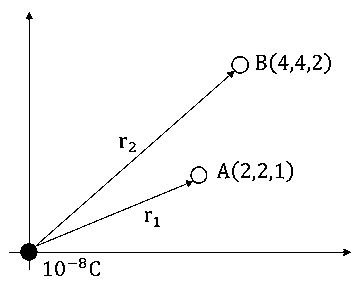
Concept:Work done by an external agent in moving a charge in an electrostatic field is equal to the change in electrostatic potential energy.Explanation:Given: source charge Q=10−8C at origin.Test charge q=2μC=2×10⁻⁶C.Distance of point (x,y,z) from origin: r=x2+y2+z2.For point A(4,4,2): rA=42+42+22=16+16+4=36=6m.For point B(2,2,1): rB=22+22+12=4+4+1=9=3m.Potential due to point charge: V=krQ, where k=9×10⁹Nm2/C2.VA=6(9×109)(10−8)=690=15V.VB=3(9×109)(10−8)=390=30V.Work done: W=q(VB−VA)=(2×10⁻⁶)(30−15)=(2×10⁻⁶)(15)=30×10−6J.
Answer:Work done is 30×10−6J, which corresponds to option (A).