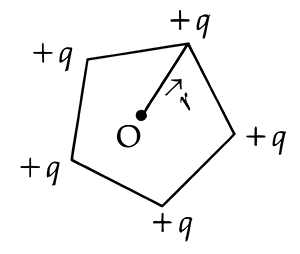
Concept:Electric potential is a scalar quantity, so the potentials due to all the charges add algebraically.Electric field is a vector quantity, so the individual fields must be added as vectors, keeping their directions in mind.Potential at the centre O:In the regular pentagon shown, every vertex is at the same distance r from the centre O.Potential due to one charge q at the centre is Vi=4πϵ01rq.Since V is a scalar, the five equal contributions simply add:V=5×4πϵ01rq=4πϵ0r5q.So V is positive and non-zero, which rules out the option claiming V=0.Electric field at the centre O:Each charge creates at O a field of the same magnitude Ei=4πϵ01r2q.Since all charges are positive, each field points radially away from its vertex, i.e. along the line joining that vertex to O.Hence the five field vectors at O have equal magnitudes and their directions are equally spaced, differing by 72∘ from one another (symmetry of the regular pentagon).Adding them head to tail closes a regular pentagon, so their vector sum is zero.Therefore E=E1+E2+E3+E4+E5=0.Why the other options are wrong:E=4πϵ0r25qr^ wrongly treats the five fields as parallel vectors and adds their magnitudes as scalars.E=8πϵ0r253qr^ is not produced by this symmetric arrangement of five equal charges on a circle.The option with V=0 is wrong because potential is a scalar addition of five positive contributions, not a vector cancellation.Answer:V=4πϵ0r5q and E=0, which is option B — the currently marked answer is correct.