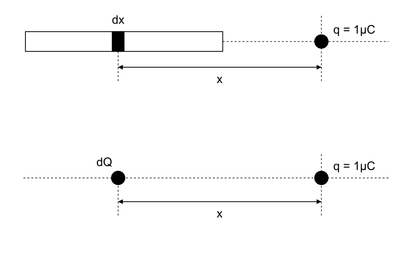
Concept:The wire is a continuous distribution of charge, so the net force on the point charge
q is obtained by integrating the Coulomb force due to each infinitesimal element of the wire.
Both
q and
Q are positive, so the force is repulsive (directed away from the wire).
Step 1 — Linear charge density of the wire:λ=LQ=0.124×10−6=2.4×10⁻⁴ C/m.
Step 2 — Force due to one element:Take an element of length
dx at a distance
x from
q, so its charge is
dQ=λdx.
dF=4πε01x2qdQ=x2kqλdx,k=4πε01=9×10⁹ Nm2/C2Step 3 — Integrate along the wire:The near end of the wire is at
x1=2 cm=0.02 m and the far end at
x2=2+10=12 cm=0.12 m.
F=∫0.020.12x2kqλdx=kqλ[−x1]0.020.12=kqλ(0.021−0.121)Since
λ=LQ and
L=x2−x1, this reduces to the compact result
F=x1x2kqQ=0.02×0.12kqQStep 4 — Substitution:k=9×10⁹ Nm2/C2,
q=1μC=10−6 C,
Q=24μC=24×10−6 C.
F=0.02×0.129×109×10−6×24×10−6=0.00240.216=90 NAnswer:The force between
q and the wire is
90 N (repulsive, since both charges are positive), so the net force is
90 N.