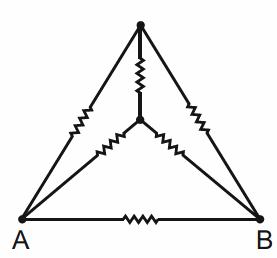
Each of the six segments (three outer edges and the three inner spokes from the central junction) is a resistor of equal length, so each segment has resistance
R1=6R.
The figure is a tetrahedron: apex
D (top vertex) and base vertices
A,
B,
C (the central junction), with every pair of vertices joined by one segment of resistance
R1.
By left-right symmetry, the nodes
C and
D are equidistant from
A and
B, so they are at the same potential.
Hence no current flows through the segment
CD, and nodes
C and
D can be merged.
Therefore, between
A and
B there are three parallel branches:
(i) the direct edge
AB of resistance
R1,
(ii) the path
A→C→B of resistance
2R1,
(iii) the path
A→D→B of resistance
2R1.
So
RAB=R1∥2R1∥2R1.
RAB1=R11+2R11+2R11=R12⇒RAB=2R1=21×6R=12RComparing with
RAB=nR gives
n=12.
Hence the correct option is
12.