Concept:Use
τ=Itotalα about the fixed axis
AB.
The axis
AB is perpendicular to the rod, so it is parallel to a diameter of each disc, and the parallel-axis theorem applies.
Given:Mass of each disc,
M=600 g; radius,
R=10 cm.
Mass of the rod,
Mrod=600 g; length of the rod,
L=30 cm.
Applied torque,
τ=43×105 dyne⋅cm.
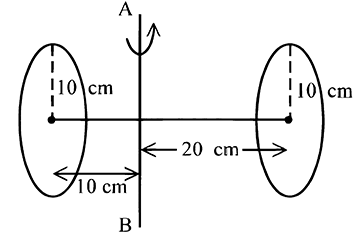
From the figure,
AB is
20 cm from the centre of the right disc, hence
30−20=10 cm from the centre of the left disc.
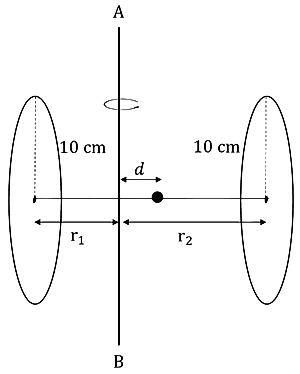
Moment of inertia of the rod about AB:The rod's centre of mass is at its midpoint,
15 cm from either end, i.e.
15−10=5 cm from
AB.
Irod=12MrodL2+Mrodd2=12600×302+600×52=45000+15000=60000 g⋅cm2.
Moment of inertia of the discs about AB:Moment of inertia of a disc about its diameter is
41MR2.
Left disc, whose centre is at
d1=10 cm from
AB:
I1=41MR2+Md12=41(600)(10)2+600(10)2=15000+60000=75000 g⋅cm2.
Right disc, whose centre is at
d2=20 cm from
AB:
I2=41(600)(10)2+600(20)2=15000+240000=255000 g⋅cm2.
Total moment of inertia:Itotal=Irod+I1+I2=60000+75000+255000=390000 g⋅cm2=3.9×10⁵ g⋅cm2.
Angular acceleration:α=Itotalτ=3.9×10543×105=11.03 rad/s2≈11 rad/s2.
Answer:α≈11 rad/s2 (Option D).