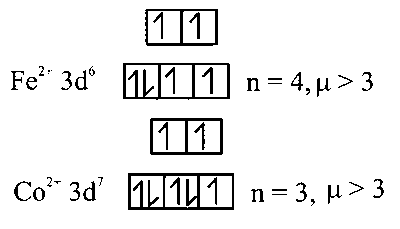
Concept:The spin-only magnetic moment, μ=n(n+2) Bohr Magneton, depends on the number of unpaired electrons n in the metal ion.Explanation:First, write the electronic configurations of the given ions (considering the loss of 4s electrons before 3d): Co2+: [Ar]3d7Ni2+: [Ar]3d8Fe2+: [Ar]3d6V3+: [Ar]3d2Ti2+: [Ar]3d2 For a spin-only moment >3.0 BM, we need n(n+2)>9 i.e. n>3 approximately. Thus only ions with more than 3 unpaired electrons qualify. In high-spin octahedral complexes: Fe2+ (d6) gives 4 unpaired electrons (t2g4eg2). Co2+ (d7) gives 3 unpaired electrons (t2g5eg2). The other ions (Ni2+, V3+, Ti2+) have 2 or fewer unpaired electrons, so their μ values are ≤3.0 BM. Therefore, the required ions are Fe2+ and Co2+. Number of unpaired electrons in high-spin complexes: Fe2+=4, Co2+=3. Sum =4+3=7.