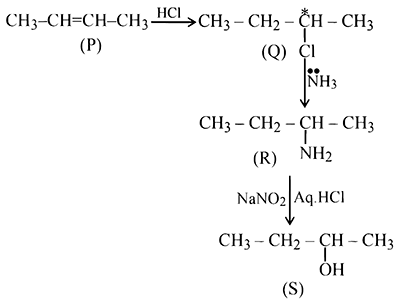
Concept:The reaction sequence involves electrophilic addition of HCl to an alkene, nucleophilic substitution with ammonia, and diazotization followed by hydrolysis to convert an amine to an alcohol.
Explanation:Step 1: Hydrocarbon P (
C4H8) is an alkene. Addition of HCl yields an alkyl halide Q (
C4H9Cl). Since Q is optically active, it must have a chiral carbon. This occurs when the alkene is unsymmetrical such that the product has a chiral centre. Hence, P is but-1-ene (
CH2=CH−CH2−CH3) and Q is 2-chlorobutane (
CH3−CHCl−CH2−CH3).
Step 2: Q reacts with one mole of ammonia in a nucleophilic substitution reaction. The chlorine atom is replaced by an amino group, giving R (
C4H11N) which is 2-aminobutane (
CH3−CH(NH2)−CH2−CH3).
Step 3: R undergoes diazotization with
NaNO2 and
HCl to form a diazonium salt. This salt is then hydrolyzed with water, replacing the diazonium group with a hydroxyl group. The product S (
C4H10O) is butan-2-ol (
CH3−CH(OH)−CH2−CH3).
Answer:The correct option is the one showing P as but-1-ene, Q as 2-chlorobutane, R as 2-aminobutane, and S as butan-2-ol.