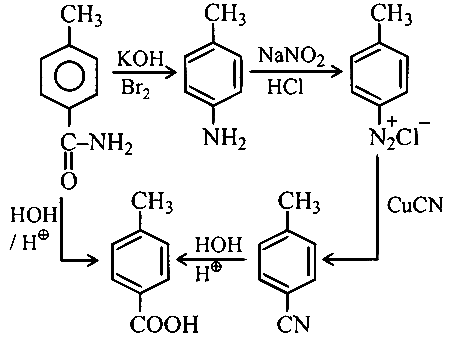
Concept:The reaction sequence involves Hoffmann bromamide degradation, diazotization, Sandmeyer reaction, hydrolysis, and oxidation. The final compound
F has exactly two different types of hydrogen atoms, indicating a highly symmetric para‑disubstituted benzene.
Explanation:Compound
A with molecular formula
C8H9ON is a neutral primary amide.
On treatment with
Br2/HO−, it undergoes Hoffmann degradation to give amine
B (one carbon less,
C7H9N).
B is soluble in dilute acid, confirming it is an aromatic amine.
B with
NaNO2/HCl at
0−5∘C forms diazonium salt
C.
C reacts with
CuCN/NaCN (Sandmeyer reaction) to give nitrile
D.
Hydrolysis of
D yields carboxylic acid
E (
C7H7O2). The same
E is obtained by direct hydrolysis of
A, so
E corresponds to the acyl part of
A.
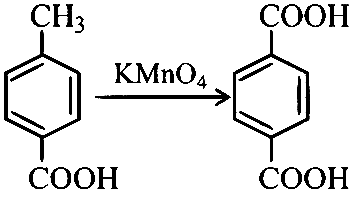
E on oxidation with acidified
KMnO4 gives
F.
F has only two types of hydrogen atoms. This occurs when
F is a para‑dicarboxylic acid (e.g., terephthalic acid).
Therefore,
E must be a methylbenzoic acid, and oxidation of the methyl group gives the symmetric acid. The para isomer is the only one that yields
F with two equivalent ring hydrogens and two equivalent carboxyl hydrogens.
Thus
A is 4‑methylbenzamide (
CH3−C6H4−CONH2).
Shortcut:If the final oxidation product has exactly two types of
H, it must be a para‑disubstituted benzene with identical groups (like terephthalic acid). Hence the starting amide must have a methyl group para to the amide group.
Answer:The correct option is the structure of 4‑methylbenzamide (para ‑
CH3 and
−CONH2 on benzene ring).
(Since the options are images, select the one with the amide group at position 1 and methyl group at position 4.)