Test Index
Basics of Organic Chemistry
Show Para
Paragraph for next 2 questions The amount of energy required to break a bond is same as the amount of energy released when the same bond is formed. In gaseous state, the energy required for homolytic cleavage of a bond is called Bond Dissociation Energy (BDE) or Bond Strength. BDE is affected by -character of the bond and the stability of the radicals formed. Shorter bonds are typically stronger bonds. BDEs for some bonds are given below :
© examsnet.com
Question : 2 of 39
Marks:
+1,
-0
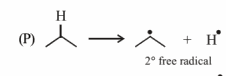
Correct match of the bonds (shown in bold) in Column with their BDE in Column is(S)
| Column J Molecule | Column K BDE (kcal mol ) |
|---|---|
| (P) | (i) 132 |
| (Q) | (ii) 110 |
| (R) | (iii) 95 |
| (S) | (iv) 88 |
[JEE Adv 2021 P2]
Go to Question: