Examsnet
Unconfined exams practice
Home
Exams
Banking Entrance Exams
CUET Exam Papers
Defence Exams
Engineering Exams
Finance Entrance Exams
GATE Exam Practice
Insurance Exams
International Exams
JEE Exams
LAW Entrance Exams
MBA Entrance Exams
MCA Entrance Exams
Medical Entrance Exams
Other Entrance Exams
Police Exams
Public Service Commission (PSC)
RRB Entrance Exams
SSC Exams
State Govt Exams
Subjectwise Practice
Teacher Exams
SET Exams(State Eligibility Test)
UPSC Entrance Exams
Aptitude
Algebra and Higher Mathematics
Arithmetic
Commercial Mathematics
Data Based Mathematics
Geometry and Mensuration
Number System and Numeracy
Problem Solving
Board Exams
Andhra
Bihar
CBSE
Gujarat
Haryana
ICSE
Jammu and Kashmir
Karnataka
Kerala
Madhya Pradesh
Maharashtra
Odisha
Tamil Nadu
Telangana
Uttar Pradesh
English
Competitive English
CBSE
CBSE Question Papers
NCERT Books
NCERT Exemplar Books
NCERT Study Notes
CBSE Study Concepts
CBSE Class 10 Solutions
CBSE Class 12 Solutions
NCERT Text Book Class 11 Solutions
NCERT Text Book Class 12 Solutions
ICSE Class 10 Papers
Certifications
Technical
Cloud Tech Certifications
Security Tech Certifications
Management
IT Infrastructure
More
About
Careers
Contact Us
Our Apps
Privacy
Test Index
IIT JEE Advanced 2008 Paper 2
Show Para
Hide Para
Share question:
© examsnet.com
Question : 5
Total: 66
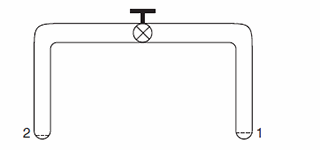
A glass tube of uniform internal radius (r) has a valve separating the two identical ends. Initially, the valve is in a tightly closed position. End 1 has a hemispherical soap bubble of radius r. End 2 has sub-hemispherical soap bubble as shown in figure. Just after opening the valve,
[JEE Adv 2008 P2]
air from end 1 flows towards end 2. No change in the volume of the soap bubbles.
air from end 1 flows towards end 2. Volume of the soap bubble at end 1 decreases.
no change occurs.
air from end 2 flows towards end 1. Volume of the soap bubble at end 1 increases.
Validate
Solution:
The air flows from high-pressure region to low-pressure region.
Therefore,
P =
P
0
+
4
T
R
where
P
0
is the atmospheric pressure, T the surface tension and R the radius of curvature of the bubble. Thus,
P
2
=
P
0
+
4
T
R
2
However,
R
1
<
R
2
; thus, the air flows from 1 to 2.
© examsnet.com
Go to Question:
1
2
3
4
5
6
7
8
9
10
11
12
13
14
15
16
17
18
19
20
21
22
23
24
25
26
27
28
29
30
31
32
33
34
35
36
37
38
39
40
41
42
43
44
45
46
47
48
49
50
51
52
53
54
55
56
57
58
59
60
61
62
63
64
65
66
Prev Question
Next Question
Similar Free Exams:
AIEEE Previous Papers
BITSAT Exam Previous Papers
JEE Advanced Chapters Wise Questions
JEE Advanced Model Papers
JEE Mains Chapters Wise Previous Papers
JEE Mains Model Papers
JEE Mains Previous Papers
VITEEE Previous Papers