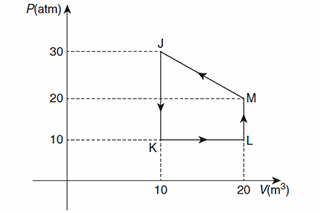
We observe the following:
• Process JK: Isochoric process; hence, ΔW = 0, ΔQ = ΔU.
Therefore, P decreases; T decreases; thus, ΔU < 0, ΔQ < 0.
Hence, (A) → (Q)
• Process KL: Isobaric process; hence, ΔW = 10
(VL–VK) > 0
as
VL >
VK.
Therefore, V increases, T increases; thus, ΔU > 0, ΔQ > 0.
Hence, (B) → (P), (S)
• Process LM: Isochoric process; hence, ΔW = 0, ΔQ = ΔU.
Therefore, P increases, T increases; thus, ΔU > 0, ΔQ > 0.
Hence, (C) → (S)
• Process MJ: ΔW < 0 as V decreases.
TM =
TJ =
Since
TJ <
TM, ΔU < 0. Therefore, ΔQ < 0.
Hence, (D) → (Q), (R)