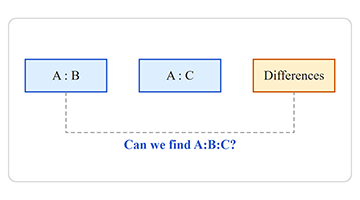
Concept:To determine a unique ratio of three ages, we need consistent independent equations relating a, b, and c.Statement III creates ambiguity through absolute differences, and no valid unique set of ages is obtained.Explanation:Let the present ages of A, B, and C be a, b, and c.From Statement I: b+5a+5=54⇒5a−4b=−5.From Statement II: c−7a−7=43⇒4a−3c=7.From Statement III: ∣a−b∣=5 and ∣b−c∣=5.Combining I with ∣a−b∣=5, the only valid positive case is b=a+5.So, 5a−4(a+5)=−5⇒a=15, b=20.Using II: 4(15)−3c=7⇒c=353.But ∣b−c∣=20−353=37=5.Thus, all three statements contradict each other.Also, Statements II and III together allow multiple possible age sets.Therefore, the ratio of ages after 10 years cannot be uniquely determined.
Answer:D. All three statements together are not sufficient.