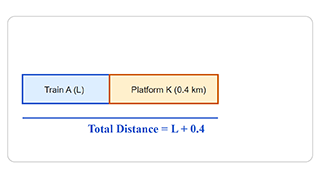
Concept:When a train crosses a platform, the total distance covered is the sum of the train's length and the platform's length.
Time is calculated as Distance ÷ Speed.
Use the given 1-hour difference to find this effective distance, then scale it by 10.
Explanation:Let the length of each train be
L km.
The platform length is
400 m
=0.4 km.
Speed of Train A
=Y km/hr.
Speed of Train B
=Y+10 km/hr, since Train A is 10 km/hr slower.
Time taken by Train A to cross the platform is
YL+0.4.
Time taken by Train B to cross the platform is
Y+10L+0.4.
Train A takes 1 hour longer than Train B, so:
YL+0.4−Y+10L+0.4=1(L+0.4)[Y1−Y+101]=1(L+0.4)[Y(Y+10)10]=1L+0.4=10Y(Y+10)Now, both the train length and platform length are multiplied by 10.
So the new distance becomes
10(L+0.4).
New time taken by Train A
=Y10(L+0.4)Substitute
L+0.4=10Y(Y+10):
New time
=Y10×10Y(Y+10)=YY(Y+10)=Y+10 hours.
Answer:The new time taken by Train A is
(Y+10) hours.
Correct option: D.
(Y+10) hours.