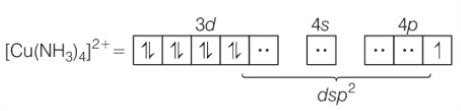
(a) In
[Cu(NH3)4]2+, in the presence of ligand
NH3,Cu2+ ions show the following electronic configuration.
Note In which one electron of
3d is transfered to
4p.
The above complex show colour due to
d−d transition.
(b) In
CrO42−, Cr in compound
CrO42− offer colour due to charge transfer from metal to
π∗ orbitals of ligand and not due to
d−d transition.
(c) In
[CoF6]3−, in the presence of weak ligand (i.e. fluorine),
Co3+ ions show the following electronic configuration,
The above complex has unpaired electrons and can show colour due to
d−d transition.
(d) In [Ti(H
2O)6]3+The presence of weak ligand i.e.,
(H2O),Ti3+ ion show one unpaired electron and offer colour due to
d−d transition.
Hence, option (b) is the correct answer.