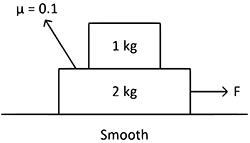
To determine the work done by the lower block on the upper block, follow these steps:
Calculate Maximum Possible Acceleration:
The maximum acceleration the upper block ( 1 kg ) can experience without sliding off is due to static friction:
amax=μg=1m/s2where
μ is the coefficient of friction and
g is the acceleration due to gravity.
Calculate Common Acceleration:
The applied force is distributed over the total mass ( 3 kg ) of the system, so the acceleration
a is:
a=mtotal F=30.5=30.5m/s2Check for Relative Motion:
Since
a<amax , the blocks will move together without slipping.
Calculate the Force of Friction:
The force of friction acting from the lower block to the upper block is:
f=mupper ⋅a=1⋅30.5=61NCalculate the Work Done by Friction:
The work done by this friction force over a displacement of 3 meters is:
W=f×s=61×3=0.5JThus, the work done by the lower block on the upper block for a displacement of 3 meters is 0.5 J .