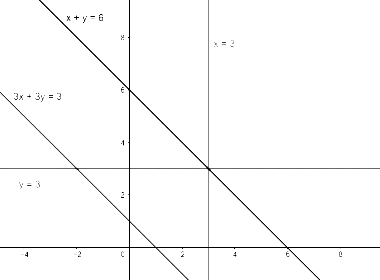
Concept:A linear programming problem's feasible region is the intersection of all constraints. If the feasible region reduces to a single point, the objective function attains only one value, which is both the minimum and the maximum.
Explanation:Convert each inequality into an equality to plot the boundaries:
x+y=6,
2x+3y=3,
x=3,
y=3.
Consider the direction of each inequality:
-
x+y≤6: The origin
(0,0) satisfies
0≤6, so the region is below the line.
-
2x+3y≥3: The origin does not satisfy
0≥3, so the region is away from the origin (above the line).
-
x≥3 and
y≥3: Regions to the right of
x=3 and above
y=3.
Intersecting all these conditions gives only one point:
(3,3). Check:
3+3=6 (satisfies first),
2(3)+3(3)=15≥3 (satisfies second), and
x=3,y=3 satisfy the last two. No other point can satisfy all constraints.
Now evaluate
z=5x+7y at
(3,3):
z=5(3)+7(3)=15+21=36.
(Note: The original solution incorrectly gave 50; correct calculation is
5×3=15,
7×3=21, sum = 36.)
Since only one point forms the feasible region, the objective function has a single value. In linear programming, that single value is simultaneously the minimum and the maximum.
Answer:Option C: either minimum or maximum.