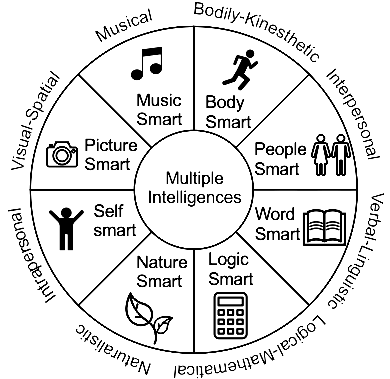
Concept:Gardner’s Multiple Intelligences Theory states that intelligence is not a single, fixed ability; instead, people possess different kinds of intelligences, and every individual is “intelligent” in at least one of these areas.
Explanation:The theory, proposed by Howard Gardner (1983), identifies at least eight distinct intelligences (e.g., linguistic, logical-mathematical, spatial, bodily‑kinesthetic, musical, interpersonal, intrapersonal, naturalistic). Each person has a unique profile of strengths. Therefore, nearly every student can be considered intelligent in some way—it simply depends on which type of intelligence is being measured. For example, a student who struggles with verbal tasks may excel in spatial or kinesthetic activities. This understanding encourages teachers to recognise and nurture diverse talents rather than focusing only on traditional academic abilities. The other options (B, C, D) do not align with the core message of Gardner’s theory.
Answer:Option A – most students can be considered “intelligent” in some way.