Test Index

Systems of Particles and Rotational Motion

© examsnet.com
Question : 27 of 33
Marks: +1, -0
Prove the result that the velocity v of translation of a rolling body (like a ring, disc, cylinder or sphere) at the bottom of an inclined plane of a height h is given by
v2=2gh1+k2R2v^{2}= \frac{2 g h}{1+\frac{k^{2}}{R^{2}}}
using dynamical consideration (i.e. by consideration of forces and torques).
Note k is the radius of gyration of the body about its symmetry axis, and R is the radius of the body. The body starts from rest at the top of the plane.
Solution:  
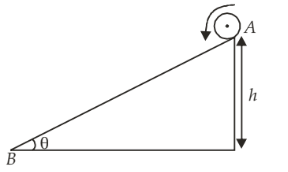
Let M, R, k be the mass, radius and radius of gyration of a body placed at the top A of the inclined plane of height h and angle of inclination θ.
∴ Its total energy at point
A=P.E.=mghA = \text{P.E.} = mgh
Its total energy at point
B = K.E. of translation + K.E. of rotation
=12mv2+12Iω2= \frac{1}{2} m v^{2}+ \frac{1}{2} I \omega^{2}
According to the principle of conservation of energy we have
12mv2+12(mk2)v2R2=mgh[∵I=mk2,ω=vR]\frac{1}{2} m v^{2}+ \frac{1}{2} (m k^{2}) \frac{v^{2}}{R^{2}} = m g h \left[\because I=m k^{2}, \omega = \frac{v}{R}\right]
⇒12mv2(1+k2R2)=mgh\Rightarrow \frac{1}{2} m v^{2} \left(1+ \frac{k^{2}}{R^{2}}\right) = m g h
∴v2=2gh1+k2R2\therefore v^{2}= \frac{2 g h}{1+\frac{k^{2}}{R^{2}}}
© examsnet.com
Go to Question: