Test Index
Laws of Motion
© examsnet.com
Question : 34 of 40
Marks:
+1,
-0
Two bodies A and B of masses 5 kg and 10 kg in contact with each other rest on a table against a rigid wall as shown in figure. 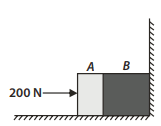 The coefficient of friction between the bodies and the table is 0.15. A force of 200 N is applied horizontally to A. What are (a) the reaction of the partition (b) the action-reaction forces between A and B? What happens when the wall is removed? Does the answer to (b) change, when the bodies are in motion? Ignore the difference between and .
Solution:
Here, mass of body A, kg, mass of body B, kgCoefficient of friction between the bodies and the table, .Horizontal force applied on body A, N(a) Reaction of partition = ?Let f = force of limitingfriction acting to the left, then ∴ If F′ = Net force to the right exerted on the partition, then∴ According to Newton’s3rd law of motionReaction of the partition = 177.5 N to the left(b) Action-reaction forces between A and B = ?Let force of limiting friction acting on body A. (∴ here ) IfP′ the net force exerted by body A on body B.Then i.e. action of A on B = P′ = 192.65 N towards right∴ According to Newton’s 3rd law of motion,Reaction of B on A = 192.5 N towards left.Note :If we assume perfect contact between bodies A and B and the rigid partition, then the self adjusting normal force on B by the partition (reaction) equals the applied force i.e. 200 N. There is no impending motion and no friction. The action-reaction forcesbetween A and B are also 200 N. When the partition is removed : When the partition is removed, the kinetic friction comes into play, the masses move together as a system of two bodies under the action of net force F′ given by If a = acceleration produced in the system, then Does the answer to (b) change if and are in motion?Yes, when the bodies arein motion, then the answer to (b) changes and can be proved as follows :When the bodies are moving, the force exerted by A on B is given by P′ – force required to produce an acceleration of 11.83 m s in body A alone Action of A on B when partition is removed = 133.35 N ∴ reaction of B on A, when partition is removed = 133.35 N to the left.
© examsnet.com
Go to Question: