Test Index
Laws of Motion
© examsnet.com
Question : 33 of 40
Marks:
+1,
-0
A monkey of mass 40 kg climbs on a rope as shown in the figure which can stand a maximum tension of 600 N. In which of the following cases will the rope break: the monkey (a) climbs up with an acceleration of 6 m s (b) climbs down with an acceleration of 4 m s (c) climbs up with a uniform speed of 5 m s (d) falls down the rope nearly freely under gravity? (Ignore the mass of the rope). 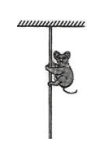
Solution:
Here, mass of monkey kgMaximum tension the rope can stand, N.In each case, actual tension in the rope will be equal to apparent weight of monkey (R).The rope will break when R exceeds T.(a) When monkey climbs up with a = 6 m s, (which is greater than T)Hence the rope will break.(b) When monkey climbs down with a = 4 m s, (which is less than T)∴ The rope will not break.(c) When monkey climbs up with a uniform speed m s, its acceleration (which is less than T)∴ The rope will not break.(d) When monkey falls down the rope nearly freely under gravity, ∴ zeroHence the rope will not break.
© examsnet.com
Go to Question: