Test Index
Wave Optics
Wave Optics

 CBSE Board Videos
© examsnet.com
Question : 8 of 31
Marks:
+1,
-0
(a) (i) A parallel beam of monochromatic light falls normally on a single slit of width 'a' and a diffraction pattern is observed on a screen placed at distance D from the slits. Explain :(I) the formation of maxima and minima in the diffraction pattern, and(II) why the maxima go on becoming weaker and weaker with its increasing number (n).(ii) Write any two points of difference between interference pattern due to double-slit and diffraction pattern due to single-slit.OR(b) (i) With the help of a ray diagram, describe the construction and working of a compound microscope.(ii) (I) The real image of an object placed between f and 2f from a convex lens can be seen on a screen placed at the image location. If the screen is removed, is the image still there ? Explain.(II) Plane and convex mirrors produce virtual images of objects. Can they produce real images under some circumstances ? Explain.
[CBSE 2026 55/5/2]
Solution:
(a)(i)(I)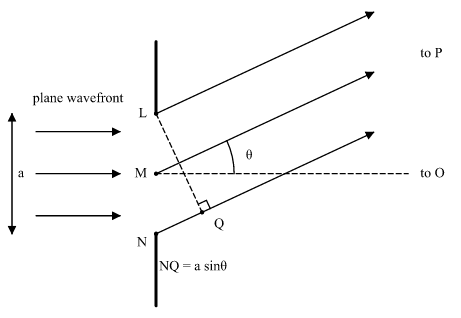 Let LN be the slit of width a and M its midpoint. Every point of the plane wavefront in the slit acts as a source of secondary wavelets. Consider waves going at angle to a point P on the far screen. The path difference between the waves from the two edges is .Central maximum (): all wavelets travel equal paths to O and arrive in phase, so intensity is maximum.Minima: when , divide the slit into two halves LM and MN. For every point in LM there is a point in MN, away, whose wave has a path difference . These pairs cancel, so the intensity is zero. In the same way, dividing the slit into parts gives zero intensity whenever, i.e. ()Secondary maxima: when , divide the slit into three equal parts. The waves from the first two thirds cancel each other; the last third is left uncancelled and gives a maximum (weaker than the central one). In general, secondary maxima occur at, i.e.
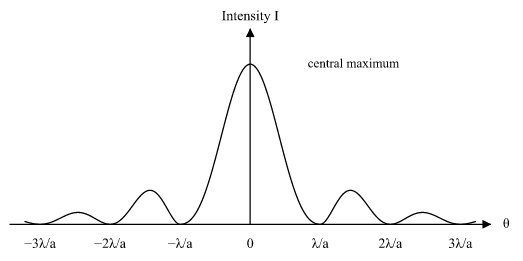 (a)(i)(II) For the th secondary maximum the slit is divided into equal parts. All but one part cancel in pairs, so only of the slit contributes. As increases this uncancelled fraction gets smaller (), so the maxima become weaker and weaker.(a)(ii) Any two:
OR (b)(i)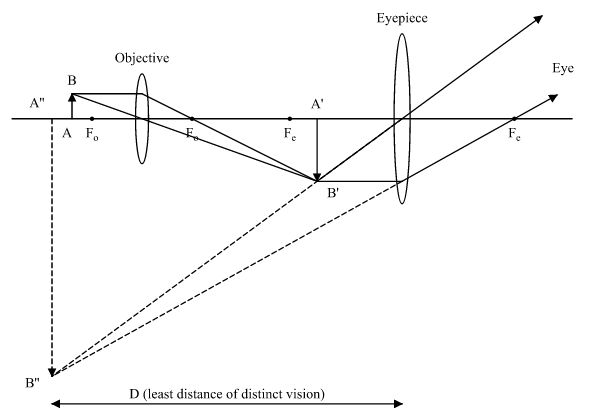 Construction: two convex lenses fixed coaxially at the ends of a tube. The objective has a very short focal length and small aperture; the eyepiece has a larger focal length and larger aperture. The distance between them can be adjusted.Working: the small object AB is placed just beyond the focus of the objective. The objective forms a real, inverted and magnified image A'B' in the tube. The eyepiece is adjusted so that A'B' lies just within its focus ; the eyepiece then works as a simple magnifier and forms the final image A''B'', which is virtual, magnified and inverted with respect to the object, at the near point (distance D = 25 cm) or at infinity.Magnifying power: , with (L = tube length)Final image at near point: ; at infinity: (b)(ii)(I) Yes. A real image is formed where the refracted rays actually meet; it exists whether or not a screen is there. The screen only scatters the light so that we can see the image from any direction. Without the screen the rays still meet at that point and then diverge, so an eye placed beyond the image (in line with the lens, at a comfortable distance) sees the image hanging in the air.(b)(ii)(II) Yes, when the light falling on them is a converging beam (a virtual object behind the mirror).Plane mirror: a beam converging towards a point a distance x behind the mirror is reflected and actually meets at a point x in front of the mirror, a real image.Convex mirror: if a converging beam is directed towards a point behind the mirror lying between its pole and its focus, the reflected rays converge in front of the mirror and form a real image. (From with a virtual object at , comes out negative, i.e. real, when .)Such a converging beam can be obtained, for example, from a convex lens placed in front of the mirror.
| Interference (double slit) | Diffraction (single slit) |
| Superposition of two waves from two coherent sources (the two slits). | Superposition of a continuous family of secondary wavelets from different points of the same wavefront. |
| All fringes have (nearly) equal width. | The central maximum is twice as wide as the other maxima. |
| All bright fringes have (nearly) equal intensity. | Intensity of the maxima falls rapidly with order. |
| At there is a maximum. | At there is a minimum. |
© examsnet.com
Go to Question: