Test Index
Wave Optics
Wave Optics

 CBSE Board Videos
© examsnet.com
Question : 7 of 31
Marks:
+1,
-0
In a Young's double-slit experiment, the two slits behave as coherent sources. When coherent light waves superpose over each other they create an interference pattern of successive bright and dark regions due to constructive and destructive interference.Two slits apart are illuminated by a source of monochromatic light and the interference pattern is observed on a screen away from the slits as shown in the figure.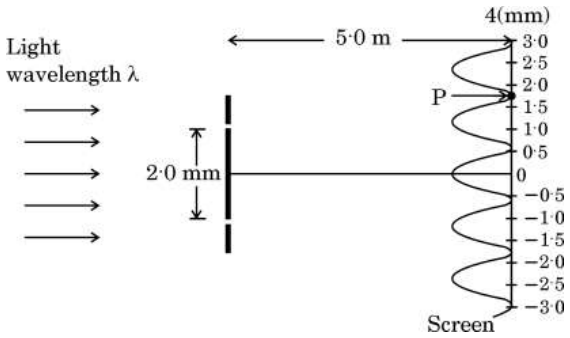 (i) What property of light does this interference experiment demonstrate ?(A) Wave nature of light(B) Particle nature of light(C) Transverse nature of light(D) Both wave nature and transverse nature of light(ii) (a) The wavelength of light used in this experiment is :(A) (B) (C) (D) OR(b) The fringe width in the interference pattern formed on the screen is :(A) (B) (C) (D) (iii) The path difference between the two waves meeting at point P, where there is a minimum in the interference pattern is :(A) (B) (C) (D) (iv) When the experiment is performed in a liquid of refractive index greater than 1, then fringe pattern will :(A) disappear(B) become blurred(C) be widened(D) be compressed
[CBSE 2026 55/5/2]
Solution:
Concept:In Young's experiment the fringe width is . Dark fringes (minima) lie at , where the path difference is an odd multiple of .Reading the figure: the scale on the screen gives the distance from the centre in mm. The intensity curve is maximum at and falls to zero (dark fringes) at . Two successive dark fringes are apart, so . Point P is at , the second dark fringe.(i) Interference (bright and dark fringes from the superposition of two coherent waves) is a property of waves, so it shows the wave nature of light. It cannot show whether the waves are transverse or longitudinal (sound waves also interfere); the transverse nature is shown by polarisation.Answer: (A) Wave nature of light(ii)(a) Given: , , Answer: (C) OR (b) From the figure, the distance between two consecutive dark fringes (or bright fringes) is .Answer: (A) (iii) P () is the second dark fringe, where the path difference is .Path difference (Check: .)Answer: (B) (iv) In a liquid of refractive index the wavelength becomes , so . The fringes come closer together; the pattern does not vanish.Answer: (D) be compressed
© examsnet.com
Go to Question: