Test Index
Ray Optics and Optical Instruments
Ray Optics and Optical Instruments

 CBSE Board Videos
© examsnet.com
Question : 37 of 46
Marks:
+1,
-0
(a) (i) Draw a labelled ray diagram showing the formation of the image at infinity by an astronomical telescope.(ii) A telescope consists of an objective of focal length cm and an eyepiece of focal length cm. If the final image is formed at infinity, then calculate :(I) the length of the tube in this adjustment, and(II) the magnification produced.OR(b) (i) Draw a labelled ray diagram showing the formation of the image at least distance of distinct vision by a compound microscope.(ii) A small object is placed at a distance of cm from a magnifier of focal length cm. Find :(I) the position of the image formed, and(II) the linear magnification produced.
[CBSE 2022 55/4/3]
Solution:
(a)(i) Astronomical telescope in normal adjustment (final image at infinity):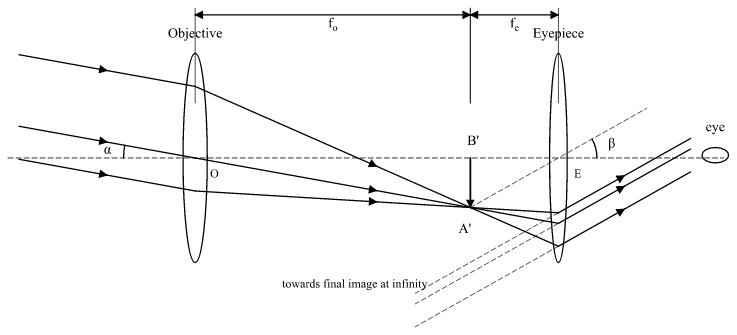 Parallel rays from a distant object make angle with the axis. The objective forms a real, inverted image A'B' at its focus, which is also the focus of the eyepiece. The rays then leave the eyepiece parallel, at angle , so the final image is at infinity.(a)(ii) Given: cm, cm, final image at infinity.(I) Length of the tube:(II) Magnification (angular):Result: cm, OR (b)(b)(i) Compound microscope with the final image at the least distance of distinct vision ():
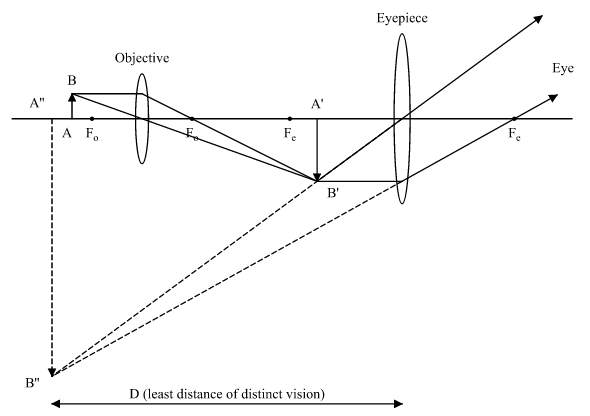 The object AB is placed just beyond the focus of the objective, which forms a real, inverted, magnified image A'B'. A'B' lies within the focus of the eyepiece, which acts as a simple magnifier and forms the final virtual, magnified image A''B'' at distance from the eye.(b)(ii) Given: cm, cm (convex lens).(I) Lens formula:The image is virtual, erect and formed 12 cm from the lens on the same side as the object.(II) Linear magnification:Result: image at 12 cm on the object side; (erect, four times enlarged).
© examsnet.com
Go to Question: