Test Index
Ray Optics and Optical Instruments
Ray Optics and Optical Instruments

 CBSE Board Videos
© examsnet.com
Question : 36 of 46
Marks:
+1,
-0
(a) (i) Draw a ray diagram showing the formation of a real image of an object placed at a distance 'u' in front of a concave mirror of radius of curvature 'R'. Hence, obtain the relation for the image distance 'v' in terms of u and R.(ii) A 1.8 m tall person stands in front of a convex lens of focal length 1 m, at a distance of 5 m. Find the position and height of the image formed.OR(b) (i) Draw a ray diagram showing refraction of a ray of light through a triangular glass prism. Hence, obtain the relation for the refractive index in terms of angle of prism (A) and angle of minimum deviation .(ii) The radii of curvature of the two surfaces of a concave lens are 20 cm each. Find the refractive index of the material of the lens if its power is D.
[CBSE 2023 55/3/1]
Solution:
(a)(i) Ray diagram and mirror relation: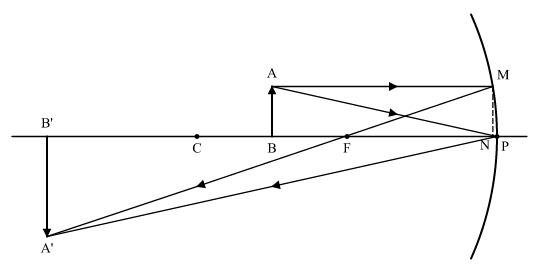 Object AB is placed beyond F (between F and C); a real, inverted image A'B' is formed. A ray from A parallel to the axis is reflected at M through F; a ray from A to the pole P is reflected making equal angles with the axis. They meet at A'.For paraxial rays, MP can be taken as a straight line perpendicular to CP, and .Triangles A'B'F and MPF are similar: ...(i)Since , triangles A'B'P and ABP are similar: ...(ii)From (i) and (ii): ...(iii)Using the sign convention: , , :Dividing by : , so With : (a)(ii) Convex lens:Given: m, m, mLens formula: mMagnification: mResult: The image is formed m behind the lens (on the other side); it is real, inverted and m tall.OR (b)(b)(i) Refraction through a prism:
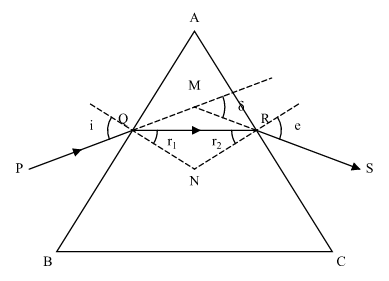 PQ is the incident ray, QR the refracted ray inside the prism and RS the emergent ray; , are the angles of incidence and emergence, , the angles of refraction at the two faces, the angle of the prism and the angle of deviation.In the quadrilateral AQNR, the angles at Q and R are right angles, so .In triangle QNR: Comparing: ...(1)Total deviation: ...(2)At minimum deviation , the ray passes symmetrically: and .From (1): From (2): By Snell's law, :(b)(ii) Concave lens:Given: D, cm, cm cmLens maker's formula: Result:
© examsnet.com
Go to Question: