Test Index
Ray Optics and Optical Instruments
Ray Optics and Optical Instruments

 CBSE Board Videos
© examsnet.com
Question : 31 of 46
Marks:
+1,
-0
(a) (i) Draw a ray diagram to show how the final image is formed at infinity in an astronomical refracting telescope. Obtain an expression for its magnifying power.(ii) Two thin lenses and , being a convex lens of focal length and a concave lens of focal length are placed coaxially at a separation of . A tall object is placed in front of the lens at a distance of . Find the location and height of the image formed by the combination.OR(b) (i) Explain the working principle of an optical fibre with the help of a diagram. Mention one use of a light pipe.(ii) A ray of light is incident at an angle of on one face of a prism with the prism angle . The ray passes symmetrically through the prism. Find the angle of minimum deviation and refractive index of the material of the prism. If the prism is immersed in water, how will be affected ? Justify your answer.
[CBSE 2023 55/4/1]
Solution:
(a)(i) Astronomical refracting telescope (final image at infinity):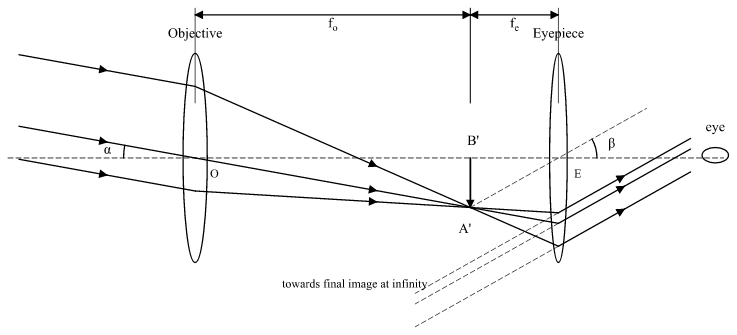 Parallel rays from a distant object, making angle with the axis, are focused by the objective (focal length ) to form a real, inverted image A'B' at its focus. A'B' is also at the focus of the eyepiece (focal length ), so the rays emerge parallel at angle and the final image is at infinity.Magnifying power (angle subtended at the eye by the final image angle subtended by the object).Let A'B' . Since the angles are small:, Result: (length of the tube ).(a)(ii) Given: : ; : ; separation ; object tall at from Image by (lens formula ):This image is beyond , so it acts as a virtual object for : Total magnification Height of the image Result: the final image is to the left of , i.e. to the left of (on the object side); it is virtual, erect and tall.Key point: The magnification of a lens combination is the product of the separate magnifications; it cannot be found by dividing the final image distance by the original object distance.OR (b)(i) Optical fibre: it consists of a thin glass or quartz core of refractive index surrounded by a cladding of lower refractive index ().Principle: total internal reflection. Light entering one end strikes the core-cladding boundary at an angle greater than the critical angle, so it is totally reflected. This repeats at every reflection, and the light travels along the fibre (even when it is bent) with very little loss, and comes out at the other end.
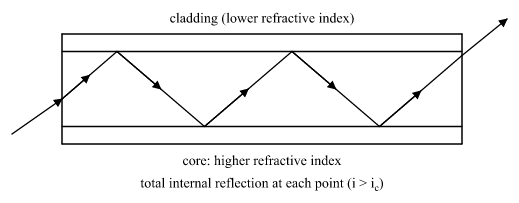 Use of a light pipe: to illuminate and view internal organs of the body (endoscopy); also to transmit optical (telephone, video and data) signals.(b)(ii) The ray passes symmetrically, so the prism is at minimum deviation: , .In water: the refractive index of the prism relative to water is , less than . Since with fixed, a smaller relative refractive index gives a smaller . So the angle of minimum deviation decreases when the prism is immersed in water.
© examsnet.com
Go to Question: