Test Index
Ray Optics and Optical Instruments
Ray Optics and Optical Instruments

 CBSE Board Videos
© examsnet.com
Question : 30 of 46
Marks:
+1,
-0
(a) (i) Trace the path of a ray of light showing refraction through a triangular prism and hence obtain an expression for angle of deviation in terms of A, i and e, where symbols have their usual meanings. Draw a graph showing the variation of angle of deviation with the angle of incidence.(ii) In the figure, a ray of light is incident on a transparent liquid contained in a thin glass box at an angle of with its one face. The emergent ray passes along the face AB. Find the refractive index of the liquid.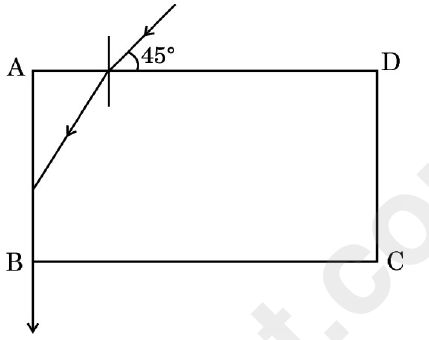 OR(b) (i) The displacement of two light waves, each of amplitude 'a' and frequency , emanating from two coherent sources of light, are given by and . is the phase difference between the two waves. These light waves superpose at a point. Obtain the expression for the resultant intensity at that point.(ii) In Young's double slit experiment, find the ratio of intensities at two points on a screen when waves emanating from two slits reaching these points have path differences (i) and (ii) .
[CBSE 2024 55/3/2]
Solution:
(a)(i) Refraction through a prism: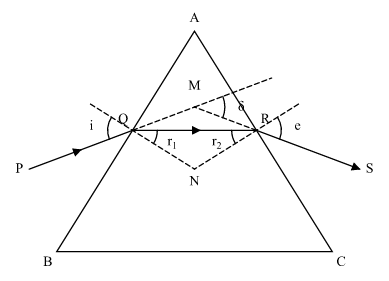 PQ is the incident ray (angle of incidence ), QR the refracted ray inside the prism, RS the emergent ray (angle of emergence ). The normals at Q and R meet at N; and are the angles of refraction at the two faces, A the angle of the prism and the angle of deviation.In quadrilateral AQNR, the angles at Q and R are each, so ...(1)In triangle QNR: ...(2)From (1) and (2): ...(3)Deviation at the first face , at the second face . Total deviation:Graph of against : as increases, first decreases, reaches a minimum value (when and the ray inside is parallel to the base), and then increases.
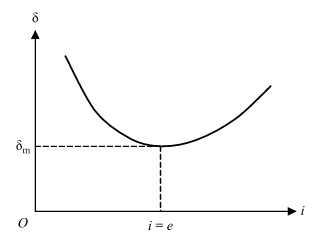 (a)(ii) The glass walls are thin, so they do not change the directions of the rays.At face AD the ray makes with the face, so the angle of incidence is . Let it refract at angle in the liquid of refractive index : ...(1)Face AB is perpendicular to face AD, so the angle of incidence at AB is . The emergent ray grazes along AB, so this angle is the critical angle: ...(2)Using :Result: OROR (b)(i) Resultant intensity:By the principle of superposition, Let ...(1) and ...(2)Then , a wave of amplitude .Squaring and adding (1) and (2):Intensity (amplitude): , where is the intensity of each wave.(b)(ii) Phase difference path difference.(1) Path difference : , (2) Path difference : , Result: (about )
© examsnet.com
Go to Question: