Test Index
Ray Optics and Optical Instruments
Ray Optics and Optical Instruments

 CBSE Board Videos
© examsnet.com
Question : 24 of 46
Marks:
+1,
-0
(a) (i) A ray of light passes through a triangular prism. Show graphically, how the angle of deviation varies with the angle of incidence ? Hence define the angle of minimum deviation.(ii) A ray of light is incident normally on a refracting face of a prism of prism angle A and suffers a deviation of angle . Prove that the refractive index n of the material of the prism is given by .(iii) The refractive index of the material of a prism is . If the refracting angle of the prism is , find the(1) Angle of minimum deviation, and(2) Angle of incidence.OR(b) (i) State Huygens’ principle. A plane wave is incident at an angle i on a reflecting surface. Construct the corresponding reflected wavefront. Using this diagram, prove that the angle of reflection is equal to the angle of incidence.(ii) What are the coherent sources of light ? Can two independent sodium lamps act like coherent sources ? Explain.(iii) A beam of light consisting of a known wavelength 520 nm and an unknown wavelength , used in Young’s double slit experiment produces two interference patterns such that the fourth bright fringe of unknown wavelength coincides with the fifth bright fringe of known wavelength. Find the value of .
[CBSE 2024 55/1/2]
Solution:
(a)(i) Variation of the angle of deviation with the angle of incidence :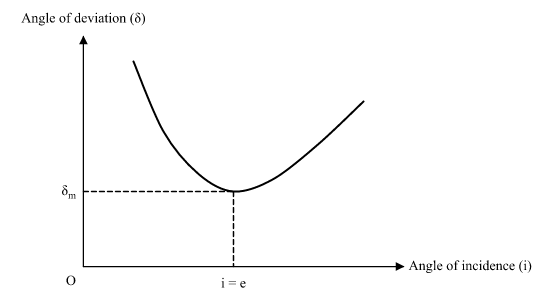 As increases, first decreases, reaches a minimum value and then increases again. Any value of above occurs for two values of (interchanging and gives the same deviation).Angle of minimum deviation: the smallest angle of deviation produced by the prism. At the angle of incidence equals the angle of emergence (), , and the refracted ray inside the prism is parallel to its base.(a)(ii)
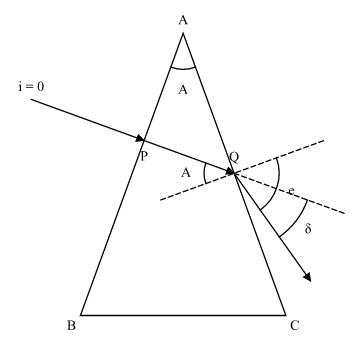 The ray falls normally on face AB (), so it goes into the prism undeviated: .For a prism, , so the angle of incidence at face AC is .If is the angle of emergence, the only deviation occurs at AC: Snell's law at face AC (glass to air): (a)(iii) Given: , (1) (2) At minimum deviation and Result: , OR (b)(i) Huygens' principle: (1) Every point on a wavefront acts as a source of secondary wavelets, which spread out in all directions with the speed of the wave in that medium. (2) The common forward envelope (tangent surface) of these secondary wavelets at any later time gives the new position of the wavefront.Reflection of a plane wavefront:
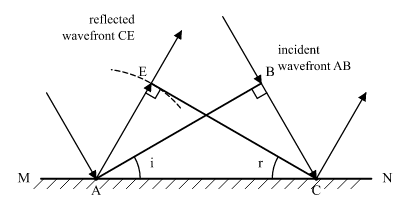 A plane wavefront AB is incident on the reflecting surface MN at angle ; its end A has just touched the surface. Let be the speed of light and the time taken by the disturbance at B to reach C, so . In this time the secondary wavelet from A spreads in the same medium to a sphere of radius . The tangent CE drawn from C to this sphere is the reflected wavefront; the reflected rays are along AE and from C, perpendicular to CE.In triangles EAC and BAC:, AC is common, and .So the triangles are congruent (RHS), giving . (between the incident wavefront and the surface) and (between the reflected wavefront and the surface) . Hence : the angle of reflection equals the angle of incidence.(b)(ii) Coherent sources: two sources of the same frequency whose phase difference remains constant with time.No, two independent sodium lamps cannot be coherent. In each lamp light is emitted by a very large number of atoms that radiate independently and randomly; the phase of the emitted light changes abruptly about every s. So the phase difference between the two lamps changes rapidly and randomly, the interference pattern shifts too fast to be seen, and only uniform illumination is observed.(b)(iii) Position of the th bright fringe: Fourth bright fringe of coincides with fifth bright fringe of nm: nmResult: nm
© examsnet.com
Go to Question: