Test Index
Ray Optics and Optical Instruments
Ray Optics and Optical Instruments

 CBSE Board Videos
© examsnet.com
Question : 23 of 46
Marks:
+1,
-0
A lens is a transparent medium bounded by two surfaces, with one or both surfaces being spherical. The focal length of a lens is determined by the radii of curvature of its two surfaces and the refractive index of its medium with respect to that of the surrounding medium. The power of a lens is reciprocal of its focal length. If a number of lenses are kept in contact, the power of the combination is the algebraic sum of the powers of the individual lenses.(i) A double-convex lens, with each face having same radius of curvature R, is made of glass of refractive index n. Its power is : (1)(A) (B) (C) (D) (ii) A double-convex lens of power P, with each face having same radius of curvature, is cut into two equal parts perpendicular to its principal axis. The power of one part of the lens will be : (1)(A) 2P(B) P(C) 4P(D) (iii) The above two parts are kept in contact with each other as shown in the figure. The power of the combination will be : (1)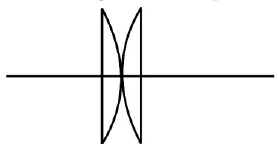 (A) (B) P(C) 2P(D) (iv) (a) A double-convex lens of power P, with each face having same radius of curvature, is cut along its principal axis. The two parts are arranged as shown in the figure. The power of the combination will be : (1)
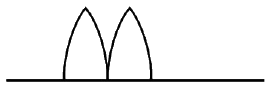 (A) Zero(B) P(C) 2P(D) OR(b) Two convex lenses of focal lengths 60 cm and 20 cm are held coaxially in contact with each other. The power of the combination is : (1)(A) 6.6 D(B) 15 D(C) D(D) D
[CBSE 2024 55/1/2]
Solution:
(i) Lens maker's formula with and :Answer: (A) (ii) Cutting perpendicular to the principal axis gives two plano-convex lenses, each with one curved face of radius and one plane face ():Answer: (D) (iii) For thin lenses in contact the powers add:Answer: (B) P(iv)(a) Cutting along the principal axis does not change the radii of curvature of the faces, so each half is still a double-convex lens of power (only its aperture is halved). The two halves placed coaxially in contact as shown act as two lenses in contact:Answer: (C) 2POR (iv)(b) m, m D(Equivalent focal length cm; is in , not dioptre.)Answer: (A) 6.6 D
© examsnet.com
Go to Question: