Test Index
Ray Optics and Optical Instruments
Ray Optics and Optical Instruments

 CBSE Board Videos
© examsnet.com
Question : 20 of 46
Marks:
+1,
-0
(a) (i) A thin pencil of length is placed coinciding with the principal axis of a mirror of focal length f. The image of the pencil is real and enlarged, just touches the pencil. Calculate the magnification produced by the mirror.(ii) A ray of light is incident on a refracting face AB of a prism ABC at an angle of . The ray emerges from face AC and the angle of deviation is . The angle of prism is . Show that the emergent ray is normal to the face AC from which it emerges out. Find the refraction index of the material of the prism.OR(b) (i) Light consisting of two wavelengths nm and nm is used to obtain interference fringes in a double slit experiment. The screen is placed m away from slits which are mm apart.(1) Calculate the distance of the third bright fringe on the screen from the central maximum for wavelength nm.(2) Find the least distance from the central maximum where the bright fringes due to both the wavelengths coincide.(ii) (1) Draw the variation of intensity with angle of diffraction in single slit diffraction pattern. Write the expression for value of angle corresponding to zero intensity locations.(2) In what way diffraction of light waves differs from diffraction of sound waves ?
[CBSE 2025 55/2/1]
Solution:
(a)(i)Concept: A real, enlarged image is formed by a concave mirror when the object lies between F and C. An object at C () forms its image at C itself. Since the image just touches the pencil, one end of the pencil is at C and the pencil lies between F and C; the other end is at a distance from the mirror.Given (sign convention): focal length , end at C: , ; other end: Mirror formula: Length of the image (it extends from C away from the mirror).Magnification (Same value from , or with signed values.)Result: : the image is real, inverted and times as long as the pencil.(a)(ii)Given: , , For a prism: Angle of emergence zero means : the ray meets AC along its normal and leaves undeviated, so the emergent ray is normal to face AC.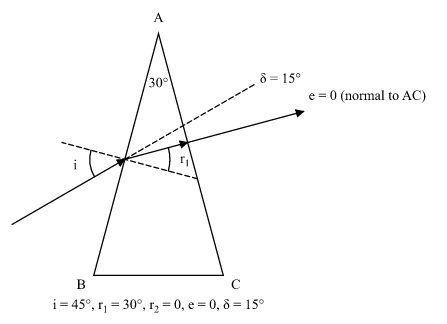 Snell's law at AB: Result: Refractive index OR (b)(i)Given: m, , m, m(1) Position of the th bright fringe: mmResult: mm(2) Bright fringes coincide where :The least whole numbers are , ( nm). mmResult: mm from the central maximum (4th bright fringe of 600 nm = 5th bright fringe of 480 nm).(b)(ii)(1) Intensity versus angle of diffraction for a single slit of width : a broad, bright central maximum, with much weaker secondary maxima on both sides.
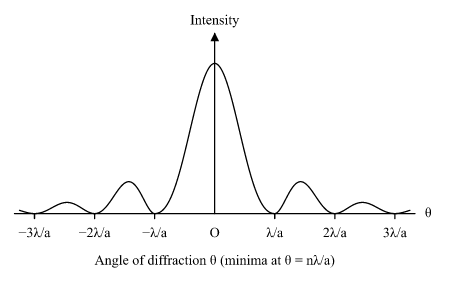 Zero intensity (minima) occurs at , (more exactly ).(b)(ii)(2) Diffraction is noticeable only when the size of the obstacle or opening is comparable to the wavelength. Sound waves have long wavelengths (about 1.7 cm to 17 m), comparable to doors, windows and walls, so sound bends around them readily and is heard round corners. Light has a very small wavelength (about 400-700 nm), so its diffraction is seen only with very narrow slits or very small obstacles; in daily life light appears to travel in straight lines and casts sharp shadows.
© examsnet.com
Go to Question: