Test Index
Ray Optics and Optical Instruments
Ray Optics and Optical Instruments

 CBSE Board Videos
© examsnet.com
Question : 19 of 46
Marks:
+1,
-0
(a) When a parallel beam of light enters water surface obliquely at some angle, what is the effect on the width of the beam?(b) With the help of a ray diagram, show that a straw appears bent when it is partly dipped in water and explain it.(c) Explain the transmission of optical signal through an optical fibre by a diagram.
[CBSE 2025 55/2/1]
Solution:
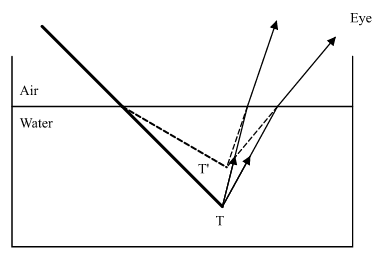
(a) The width of the beam increases. On entering water (optically denser) each ray bends towards the normal, so the angle of refraction is less than the angle of incidence . The beam width is for the same length of the surface, so .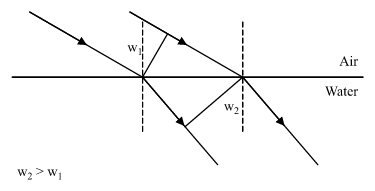 (b) Rays from the tip T of the dipped part travel from water to air and bend away from the normal at the surface. When they enter the eye, they appear to come from T, which is above T. Every point of the dipped part looks raised in the same way (apparent depth ), so the dipped part appears along OT and the straw looks bent at the water surface.
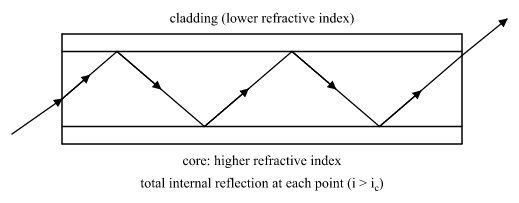
 (c) An optical fibre has a core of higher refractive index surrounded by a cladding of lower refractive index. Light entering one end strikes the core-cladding boundary at an angle greater than the critical angle, so it undergoes total internal reflection. It is reflected again and again along the length of the fibre, even when the fibre is bent, and comes out at the other end with very little loss.
© examsnet.com
Go to Question: