Test Index
Nuclei
Nuclei

 CBSE Board Videos
© examsnet.com
Question : 20 of 23
Marks:
+1,
-0
(a) (i) Prove that the nuclear density is same for all nuclei.(ii) Draw a plot of potential energy of a pair of nucleons as a function of their separation. Draw two inferences from this plot.OR(b) (i) Draw a graph to show the variation of the number of scattered particles detected (N) in Geiger-Marsden experiment as a function of scattering angle .(ii) Discuss briefly two conclusions that can be drawn from this graph and how they lead to the discovery of nucleus in an atom.
[CBSE 2023 55/3/1]
Solution:
(a)(i) Nuclear density is the same for all nuclei:The radius of a nucleus of mass number is , where m.Mass of the nucleus ( = mass of a nucleon).Volume Density This does not contain , so the nuclear density is the same for all nuclei (about ).(a)(ii) Potential energy of a pair of nucleons: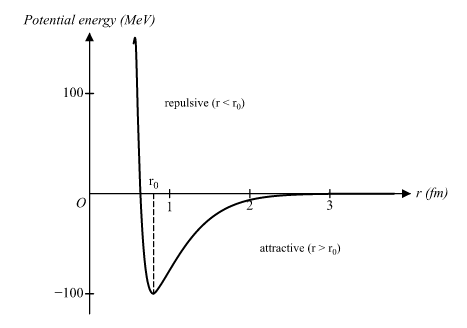 Inferences:1. The potential energy is minimum at fm. For the force is attractive, and for it is strongly repulsive.2. The nuclear force is short-ranged: beyond a few femtometres the potential energy (and the force) becomes almost zero.OR (b)(i) Graph:
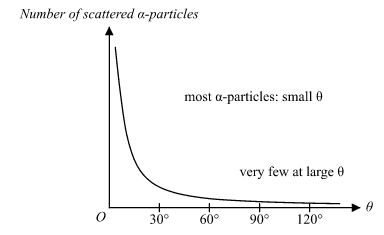 (ii) Conclusions:1. Most of the -particles pass through the gold foil undeflected or with very small deflection. So most of the atom is empty space.2. Only a very small fraction (about 1 in 8000) is scattered by more than , and a few bounce almost straight back (). To turn a heavy, fast -particle back, a very large repulsive force is needed.Discovery of the nucleus:Such a large force is possible only if the entire positive charge and almost all the mass of the atom are concentrated in a tiny central region. Rutherford called this region the nucleus (size about to m, against about m for the atom), with the electrons moving around it at large distances.
© examsnet.com
Go to Question: