Test Index
Nuclei
Nuclei

 CBSE Board Videos
© examsnet.com
Question : 19 of 23
Marks:
+1,
-0
(a) Draw a graph showing the variation of binding energy per nucleon as a function of mass number A. The binding energy per nucleon for heavy nuclei decreases with the increase in mass number. Explain.OR(b) Using Bohr's postulates, obtain the expression for radius of stable orbit in a hydrogen atom.
[CBSE 2023 55/3/1]
Solution:
(a)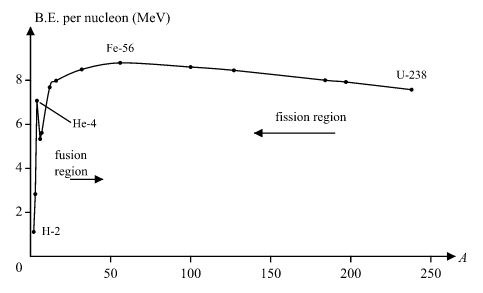 The binding energy per nucleon rises sharply for light nuclei, has a broad maximum of about MeV near (iron), and falls slowly to about MeV for (uranium).Explanation for :The nuclear force is short-ranged and shows saturation: a nucleon attracts only its nearest neighbours, so the nuclear binding contributed per nucleon stays nearly the same as the nucleus grows. The Coulomb repulsion between protons is long-ranged and does not saturate: every proton repels every other proton, so the total repulsion grows roughly as . For heavy nuclei () this growing repulsion reduces the binding, so the binding energy per nucleon decreases as increases (such nuclei are less stable and can undergo fission).OR (b)Bohr's postulates used:(1) The electron revolves in a circular orbit; the electrostatic attraction provides the centripetal force: ...(1)(2) Only those orbits are allowed for which the angular momentum is an integral multiple of : ...(2)Derivation:From (2): From (1): Substituting : For , m (Bohr radius), so m, i.e. .
© examsnet.com
Go to Question: