Test Index
Moving Charges and Magnetism
Moving Charges and Magnetism

 CBSE Board Videos
© examsnet.com
Question : 4 of 54
Marks:
+1,
-0
A circular loop has radius and carries current as shown in figure. In order that the net magnetic field at the centre of the loop is zero, the current in wire AB should have magnitude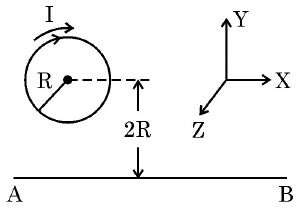
[CBSE 2026 55/1/3]
Solution:
Concept:Field at the centre of a circular loop: .Field of a long straight wire at distance : .Direction of the loop's field:The current in the loop flows clockwise as seen in the figure, so by the right-hand rule its field at the centre points into the page, i.e. along (with to the right and up, points out of the page).Magnitude:The wire is at from the centre. For zero net field:Direction of the wire current:The wire's field at the centre must point out of the page (). The centre is above the wire (along ). For current along : , so the field above the wire is along . Hence the current in AB must flow along (from A to B).Key point: Use for the wire; using gives , the trap in options C and D.Answer:Option A (, along axis)
© examsnet.com
Go to Question: