Test Index
Moving Charges and Magnetism
Moving Charges and Magnetism

 CBSE Board Videos
© examsnet.com
Question : 3 of 54
Marks:
+1,
-0
(a) The figure given below shows three straight long parallel conductors (1), (2) and (3) kept in x-y plane, carrying currents , and respectively as shown in figure.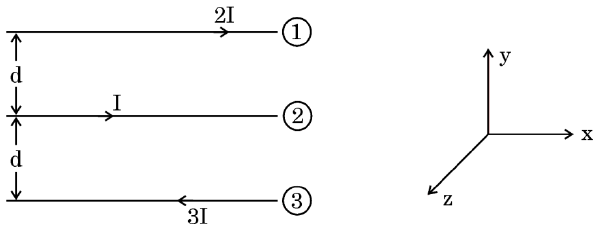 Find the magnitude and direction of:(i) net magnetic field at a point on conductor (1) and(ii) net magnetic force acting on unit length of conductor (1), due to conductors (2) and (3).OR(b) A rectangular loop of sides and and resistance '' is kept in a region in which the magnetic field varies as .(i) Derive expression for the emf induced in the loop.(ii) Find the effective value of current that flows in the loop.
[CBSE 2026 55/4/3]
Solution: 👈: Video Solution
(a)Concept: Field of a long straight wire (direction by the right-hand rule). Force per unit length between parallel wires : attractive for currents in the same direction, repulsive for opposite currents. Wire (2) is at distance and wire (3) at from wire (1); points out of the page.(a)(i) Field at wire (1) due to wire (2) (current along , point above it):, along (out of the page)Field at wire (1) due to wire (3) (current along , distance ):, along (into the page)Net field: Result: along the axis (into the plane of the paper).(a)(ii) Force per unit length on wire (1) (current ):Due to (2), same direction, attractive (towards ): Due to (3), opposite direction, repulsive (towards ): Net force per unit length: Result: along the axis (away from wires (2) and (3)).Check: , the same result.OR (b)Take the field perpendicular to the plane of the loop; area of the loop .(b)(i) Flux through the loop: By Faraday's law, Magnitude: , with peak value .(b)(ii) Instantaneous current: , so the peak current is .Effective (rms) value: Result:
© examsnet.com
Go to Question: