Test Index
Moving Charges and Magnetism
Moving Charges and Magnetism

 CBSE Board Videos
© examsnet.com
Question : 25 of 54
Marks:
+1,
-0
(a) (i) A particle of mass m and charge q is moving with a velocity in a magnetic field as shown in the figure. Show that it follows a helical path. Hence, obtain its frequency of revolution.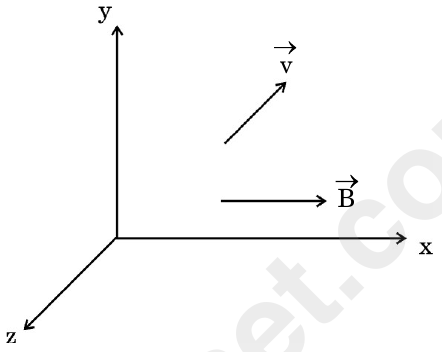 (ii) In a hydrogen atom, the electron moves in an orbit of radius Å making revolutions per second. Find the magnetic moment associated with the orbital motion of the electron.OR(b) (i) What is current sensitivity of a galvanometer ? Show how the current sensitivity of a galvanometer may be increased. “Increasing the current sensitivity of a galvanometer may not necessarily increase its voltage sensitivity.” Explain.(ii) A moving coil galvanometer has a resistance and takes mA to produce full scale deflection. How can this galvanometer be converted into a voltmeter of range 0 to V ?
[CBSE 2024 55/2/2]
Solution:
(a)(i) Let make an angle with (along the x-axis). Resolve into along and perpendicular to .The force has no part due to , so stays constant: the particle drifts uniformly along .Due to , the force is perpendicular to both and and acts as a centripetal force, so the particle moves in a circle in the plane perpendicular to :The combination of uniform circular motion perpendicular to and uniform motion along is a helical path with its axis along .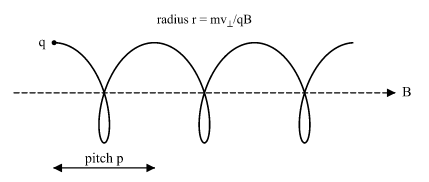 Time period: Frequency of revolution: (independent of the speed)Pitch (distance moved along in one revolution): (a)(ii) The orbiting electron is equivalent to a current . AArea of the orbit: Magnetic moment: Result: OR (b)(i) Current sensitivity of a galvanometer is the deflection per unit current: , where N = number of turns, A = area of the coil, B = magnetic field, k = torsional constant of the spring.It can be increased by increasing N, A or B, or by using a spring (suspension) of smaller k.Voltage sensitivity is the deflection per unit voltage: .If the current sensitivity is increased by increasing the number of turns N (say doubling it), the length of wire and hence the resistance R of the coil also doubles. Then , unchanged. So increasing the current sensitivity does not necessarily increase the voltage sensitivity.(b)(ii) To convert a galvanometer into a voltmeter, a high resistance R is connected in series with it.Given: , A, VResult: Connect a resistance of in series with the galvanometer.
© examsnet.com
Go to Question: