Test Index
Moving Charges and Magnetism
Moving Charges and Magnetism

 CBSE Board Videos
© examsnet.com
Question : 24 of 54
Marks:
+1,
-0
(a) Two long, straight, parallel conductors carry steady currents in opposite directions. Explain the nature of the force of interaction between them. Obtain an expression for the magnitude of the force between the two conductors. Hence define one ampere.OR(b) Obtain an expression for the torque acting on a current carrying loop in a uniform magnetic field . Draw the necessary diagram.
[CBSE 2024 55/2/2]
Solution:
(a)Two parallel conductors carrying currents in opposite directions repel each other.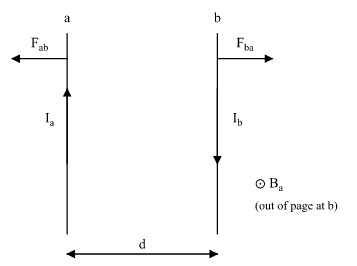 Let conductors a and b, separated by d, carry currents and in opposite directions.The magnetic field due to at every point of conductor b is, perpendicular to b (right-hand rule).Force on a length L of conductor b: By , with the currents opposite, this force points away from a. Similarly the force on a is equal and opposite, away from b. So the force per unit length is, repulsive (attractive for currents in the same direction).Definition of ampere: One ampere is that steady current which, when maintained in each of two very long, straight, parallel conductors of negligible cross-section placed 1 m apart in vacuum, produces on each conductor a force of N per metre of length.OR (b)Consider a rectangular loop with sides a and b carrying current I in a uniform field . The area vector (normal to the loop) makes an angle with .
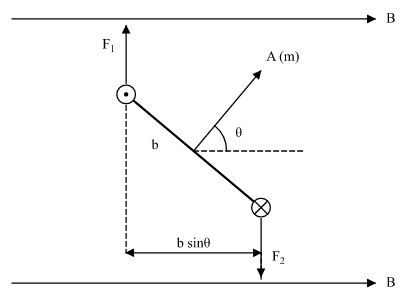 The forces on the two sides of length b are equal, opposite and along the same line (the axis of the loop), so they cancel and give no torque.The forces on the two sides of length a are (these sides are perpendicular to ). They are equal and opposite but act along different lines, so they form a couple. The perpendicular distance between their lines of action is .Torque: (with )With the magnetic moment (for N turns, ):, magnitude The torque is maximum () when the plane of the loop is parallel to () and zero when is along .
© examsnet.com
Go to Question: