Test Index
Moving Charges and Magnetism
Moving Charges and Magnetism

 CBSE Board Videos
© examsnet.com
Question : 18 of 54
Marks:
+1,
-0
(a) (i) What is the source of force acting on a current-carrying conductor placed in a magnetic field ? Obtain the expression for force acting between two long straight parallel conductors carrying steady currents and hence define 'ampere'.(ii) A point charge q is moving with velocity in a uniform magnetic field . Find the work done by the magnetic force on the charge.(iii) Explain the necessary conditions in which the trajectory of a charged particle is helical in a uniform magnetic field.OR(b) (i) A current carrying loop can be considered as a magnetic dipole placed along its axis. Explain.(ii) Obtain the relation for magnetic dipole moment of current carrying coil. Give the direction of .(iii) A current carrying coil is placed in an external uniform magnetic field. The coil is free to turn in the magnetic field. What is the net force acting on the coil ? Obtain the orientation of the coil in stable equilibrium. Show that in this orientation the flux of the total field (field produced by the loop + external field) through the coil is maximum.
[CBSE 2025 55/2/1]
Solution:
(a)(i) Source of the force: a current is a flow of charges (free electrons drifting with velocity ). Each moving charge feels the magnetic Lorentz force ; the sum of these forces on all the charge carriers is the force on the conductor, .Force between two parallel conductors: Two long straight conductors a and b carry currents and in the same direction and are a distance apart.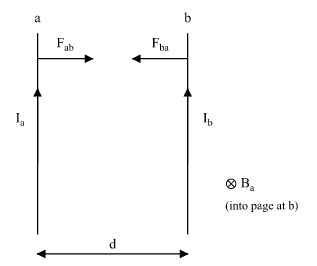 Field of a at the position of b (Ampere's circuital law): , perpendicular to b.Force on a length of b: , directed towards a.Similarly a feels an equal and opposite force towards b. Force per unit length:Currents in the same direction attract; currents in opposite directions repel.Definition of ampere: Put A, m: . One ampere is the steady current which, flowing in each of two very long, straight, parallel conductors of negligible cross-section placed 1 m apart in vacuum, produces between them a force of newton per metre of length.(a)(ii) is always perpendicular to , i.e. to the displacement .Result: Work done by the magnetic force is zero; the speed and kinetic energy of the charge do not change.(a)(iii) The path is helical when the velocity makes an angle with such that (neither parallel nor perpendicular), i.e. has components both along and perpendicular to :1. gives a force that makes the particle go round a circle of radius , period .2. feels no force, so the particle also moves uniformly along .The combination is a helix with pitch . (If the path is a straight line; if it is a circle.)OR (b)(i) A current loop behaves like a bar magnet (magnetic dipole) with its moment along its axis:1. Its field lines form the same pattern as those of a bar magnet: one face, where the current looks anticlockwise, acts as a north pole and the other face, where it looks clockwise, acts as a south pole.2. At a large distance on its axis its field is with , exactly the axial field of a magnetic dipole of moment .3. In a uniform field it feels a torque , like a dipole.(b)(ii) Field on the axis of a circular coil of turns, radius , current , at distance from its centre:For : Comparing with the axial field of a dipole, :Unit: A m. Direction: perpendicular to the plane of the coil, given by the right-hand thumb rule: curl the fingers of the right hand along the current, the thumb points along (from the south face to the north face of the coil).(b)(iii) Net force: in a uniform field the forces on opposite sides of the coil are equal and opposite, so the net force is zero (). The coil only feels a torque .Stable equilibrium: potential energy . The torque is zero at and . At , is a minimum, so this is stable: parallel to , i.e. the plane of the coil perpendicular to the external field. (, , is unstable.)Flux in this orientation: the coil's own field inside the loop points along . When , the external field also crosses the coil normally, along the same direction. Then the external flux has its largest value and adds to the loop's own flux (same sign):, the maximum possible. In any other orientation is smaller (and at it opposes the loop's flux). So in stable equilibrium the flux of the total field through the coil is maximum.
© examsnet.com
Go to Question: