Test Index
Moving Charges and Magnetism
Moving Charges and Magnetism

 CBSE Board Videos
© examsnet.com
Question : 17 of 54
Marks:
+1,
-0
(a) In a region of a uniform electric field , a negatively charged particle is moving with a constant velocity near a long straight conductor coinciding with XX axis and carrying current towards axis. The particle remains at a distance from the conductor.(i) Draw diagram showing direction of electric and magnetic fields.(ii) What are the various forces acting on the charged particle?(iii) Find the value of in terms of , and .OR(b) Two infinitely long conductors kept along XX and YY axes are carrying current and along axis and axis respectively. Find the magnitude and direction of the net magnetic field produced at point P.
[CBSE 2025 55/2/1]
Solution:
(a)(i) Take the particle (charge ) in the XY-plane at distance above the wire (the side).Magnetic field of the wire at the particle (right-hand rule, current along ): , i.e. into the plane.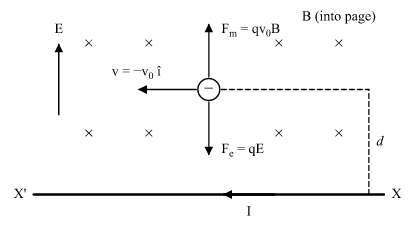 (a)(ii) Two forces act on it:Magnetic (Lorentz) force , away from the wire.Electric force . Since the velocity is constant, the net force is zero, so must be along (towards the wire), which means points along (away from the wire).(The weight of the particle is negligible.)(a)(iii) Balance of forces: Result: OR (b)
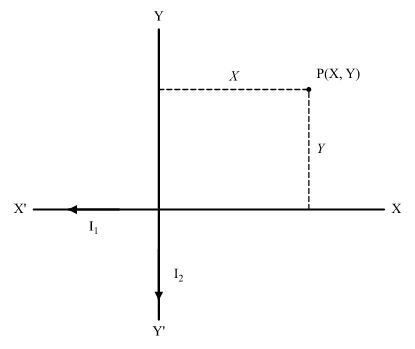 Field of a long straight wire: , direction by the right-hand rule.Wire along XX (current along ); P is at perpendicular distance from it:Wire along YY (current along ); P is at perpendicular distance from it:Net field: Result: Magnitude , directed along the Z-axis: along if and along if .
© examsnet.com
Go to Question: