Test Index
Moving Charges and Magnetism
Moving Charges and Magnetism

 CBSE Board Videos
© examsnet.com
Question : 12 of 54
Marks:
+1,
-0
(a) (i) With the help of a labelled diagram, explain the principle of working of a moving coil galvanometer. Write the purpose of using (i) radial magnetic field, and (ii) soft iron core, in it.(ii) Define current sensitivity of a galvanometer. "Increasing the current sensitivity may not necessarily increase the voltage sensitivity." Give reason.OR(b) (i) (I) Write Ampere's circuital law in mathematical form and explain the terms used.(II) As the current carrying solenoid is made longer, the magnetic field produced outside it approaches zero. Why ?(III) A flexible loop of irregular shape carrying current when located in an external magnetic field, changes to a circular shape. Give reason.(ii) A galvanometer of resistance is converted into a voltmeter to measure up to volts, by connecting a resistance in series with the coil. If is replaced by , then it can only measure up to volt. Find the value of the resistance (in terms of and ) needed to convert it into a voltmeter that can read up to .
[CBSE 2025 55/7/3]
Solution: 👈: Video Solution
(a)(i)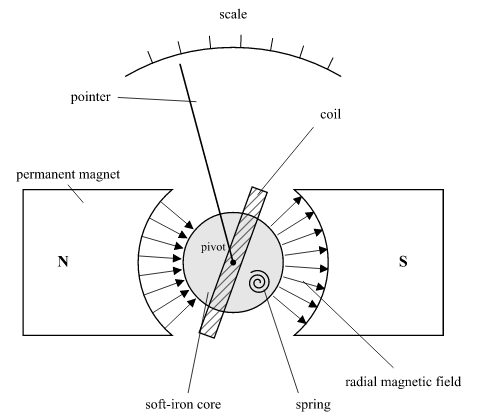 Principle: A current-carrying coil placed in a magnetic field experiences a torque.Working: A rectangular coil of turns and area is pivoted between the concave poles of a permanent magnet, around a soft-iron core. When a current flows, the deflecting torque is (the plane of the coil is always along the radial field, so ).The springs provide a restoring torque ( = torsional constant, = deflection). In equilibriumSo the deflection of the pointer on the scale is proportional to the current.Purpose of the radial magnetic field: the plane of the coil stays parallel to the field in every position, so the torque is always maximum () and ; the scale is linear (uniform).Purpose of the soft-iron core: it has high permeability, so it concentrates the field lines, increases the strength of the magnetic field in the gap (and helps make it radial), which increases the sensitivity of the galvanometer.(a)(ii)Current sensitivity is the deflection produced per unit current:Voltage sensitivity is the deflection per unit voltage: , where is the resistance of the coil.Reason: If the current sensitivity is increased by increasing the number of turns (say doubled), the length of wire, and hence the resistance , also doubles. Then doubles but stays the same. So increasing current sensitivity need not increase voltage sensitivity.OR (b)(i)(I)Ampere's circuital law: = magnetic field at the element ; = small length element of a closed loop (the Amperian loop); = line integral taken round the whole closed loop; = net current enclosed by (passing through the surface bounded by) the loop; = permeability of free space.(b)(i)(II)In a long solenoid the turns are closely wound, so the fields of neighbouring turns cancel in the region outside, and the solenoid behaves like a long cylindrical current sheet. All the field lines run along the inside, and outside they return spread over an extremely large (practically infinite) region. As the solenoid is made longer, the field lines outside become ever more spread out, so the field density, i.e. outside, approaches zero, while the field inside stays uniform ().(b)(i)(III)Each element of the flexible loop experiences a force , and these forces pull the wire outward in the plane of the loop. The loop settles where its potential energy is least, i.e. where the area (and the magnetic flux through it) is the largest. For a given perimeter, a circle encloses the maximum area, so the loop takes a circular shape.(b)(ii)Let be the full-scale current of the galvanometer. For a voltmeter of range , .With : ...(1)With : ...(2)Dividing (1) by (2): For range : ...(3)Dividing (3) by (1): Result:
© examsnet.com
Go to Question: