Test Index
Moving Charges and Magnetism
Moving Charges and Magnetism

 CBSE Board Videos
© examsnet.com
Question : 11 of 54
Marks:
+1,
-0
(a) (i) Write Biot-Savart's law in vector form.(ii) Two identical circular coils A and B, each of radius R, carrying currents I and respectively, are placed concentrically in XY and YZ planes respectively. Find the magnitude and direction of the net magnetic field at their common centre.OR(b) (i) A rectangular loop of sides and b carries a current I clockwise. Write the magnetic moment of the loop and show its direction in a diagram.(ii) The loop is placed in a uniform magnetic field and is free to rotate about an axis which is perpendicular to . Prove that the loop experiences no net force, but a torque .
[CBSE 2025 55/7/3]
Solution: 👈: Video Solution
(a)(i)The magnetic field due to a current element at a point with position vector from the element iswhere T m/A is the permeability of free space.(a)(ii)Field at the centre of a circular coil: , along the axis of the coil.Coil A (XY plane, current ): axis along z, along the z-axis.Coil B (YZ plane, current ): axis along x, along the x-axis.The two fields are perpendicular, soDirection: 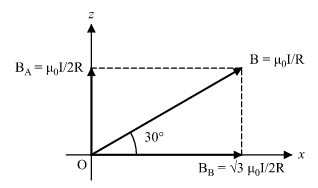 Result: , in the XZ plane at to the x-axis (axis of coil B), i.e. to the z-axis (axis of coil A).OR (b)(b)(i)Magnetic moment: , with magnitude .Its direction is along the normal to the plane of the loop given by the right-hand thumb rule: curl the fingers along the current, the thumb gives . For a current that is clockwise as seen by the viewer, points into the page (away from the viewer).
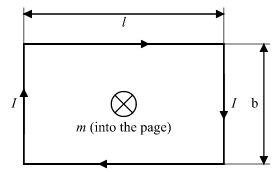 (b)(ii)No net force: The force on the loop is for uniform . For a closed loop , so . Side by side: the forces on opposite sides are equal in magnitude and opposite in direction, so they cancel.Torque: Let the axis of rotation be parallel to the sides of length (perpendicular to ), and let the normal to the loop () make angle with .1. The two sides of length b: forces on them are equal, opposite and act along the same line (the axis), so they give no torque.2. The two sides of length are perpendicular to : each feels a force , in opposite directions. They are not along the same line: the perpendicular distance between their lines of action is . They form a couple.3. Torque 4. The couple turns the loop so that moves towards ; this is the direction of . Hence
© examsnet.com
Go to Question: