Test Index
Electrostatic Potential and Capacitance
Electrostatic Potential and Capacitance

 CBSE Board Videos
© examsnet.com
Question : 7 of 28
Marks:
+1,
-0
The electric potential (V) and electric field (E) are closely related concepts in electrostatics. The electric field is a vector quantity that represents the force per unit charge at a given point in space, whereas electric potential is a scalar quantity that represents the potential energy per unit charge at a given point in space. Electric field and electric potential are related by the equations and , i.e., electric field is the negative gradient of the electric potential. This means that electric field points in the direction of decreasing potential and its magnitude is the rate of change of potential with distance. The electric field is the force that drives a unit charge to move from higher potential region to lower potential region and electric potential difference between the two points determines the work done in moving a unit charge from one point to the other point.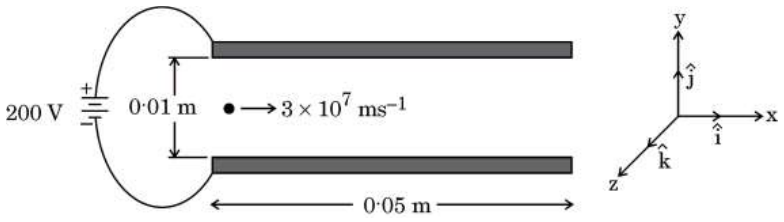 A pair of square conducting plates having sides of length are arranged parallel to each other in x-y plane. They are apart along z-axis and are connected to a power supply as shown in the figure. An electron enters with a speed of horizontally and symmetrically in the space between the two plates. Neglect the effect of gravity on the electron.(i) The electric field in the region between the plates is :(A) (B) (C) (D) (ii) In the region between the plates, the electron moves with an acceleration given by :(A) (B) (C) (D) (iii) (a) Time interval during which an electron moves through the region between the plates is :(A) (B) (C) (D) OR(b) The vertical displacement of the electron which travels through the region between the plates is :(A) (B) (C) (D) (iv) Which one of the following is the path traced by the electron in between the two plates ?
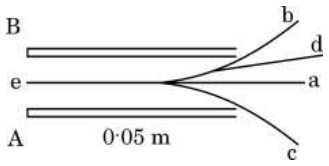 (A) a(B) b(C) c(D) d
[CBSE 2026 55/5/2]
Solution:
Concept:Between parallel plates the field is uniform, , directed from the positive plate to the negative plate. The force on the electron, , is opposite to , i.e. towards the positive plate. Along the plates (x) there is no force, so the electron moves like a horizontally thrown projectile.Given: , , , , , (i) The plates are separated along z. The upper plate (the one shown on top in the figure, at larger z) is joined to the positive terminal, so it is at the higher potential. points from higher to lower potential, i.e. towards .Answer: (D)(ii) The electron's charge is negative, so is opposite to , i.e. along (towards the positive plate).Answer: (B)(iii)(a) The horizontal velocity is unchanged, soAnswer: (C) OR (b) The electron starts with zero velocity along z, soThis is just less than half the gap (), so the electron just gets out without hitting the plate.Answer: (B) (iv) Inside the plates the electron has a constant sideways acceleration towards the positive plate (B side), so its path there is a parabola bending towards B. After it leaves the plates there is no field, so it moves along a straight line (the tangent to the parabola at the exit point). Path d shows exactly this: curved between the plates, straight outside. Path b keeps bending even outside the field, path a is undeflected and path c bends towards the negative plate.Key point: The field exists only between the plates. Once the electron leaves them no force acts on it, so it must move in a straight line; a path that goes on curving outside the plates (b) is not possible.Answer: (D) d
© examsnet.com
Go to Question: