Test Index
Electrostatic Potential and Capacitance
Electrostatic Potential and Capacitance

 CBSE Board Videos
© examsnet.com
Question : 22 of 28
Marks:
+1,
-0
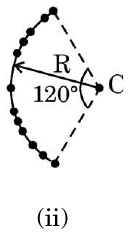
(a) Twelve negative charges of same magnitude are equally spaced and fixed on the circumference of a circle of radius R as shown in Fig. (i). Relative to potential being zero at infinity, find the electric potential and electric field at the centre C of the circle.(b) If the charges are unequally spaced and fixed on an arc of of radius R as shown in Fig. (ii), find electric potential at the centre C.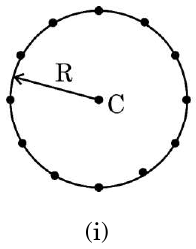
[CBSE 2023 55/1/1]
Solution:
Concept:Potential is a scalar: . Electric field is a vector and the fields of the charges add as vectors.(a) Each of the 12 charges is and is at the same distance from C.Electric field: the charges are equally spaced, so for every charge there is an identical charge diametrically opposite (6 such pairs). The fields of each pair at C are equal and opposite and cancel. By symmetry, .(b) Potential depends only on the charges and their distances from C, not on their arrangement. All 12 charges are still at distance , so (unchanged).(The field at C is no longer zero here, since the charges are not symmetric.)Result: (a) , ; (b)
© examsnet.com
Go to Question: