Test Index
Electrostatic Potential and Capacitance
Electrostatic Potential and Capacitance

 CBSE Board Videos
© examsnet.com
Question : 21 of 28
Marks:
+1,
-0
Electrostatics deals with the study of forces, fields and potentials arising from static charges. Force and electric field, due to a point charge is basically determined by Coulomb's law. For symmetric charge configurations, Gauss's law, which is also based on Coulomb's law, helps us to find the electric field. A charge/a system of charges like a dipole experience a force/torque in an electric field. Work is required to be done to provide a specific orientation to a dipole with respect to an electric field.Answer the following questions based on the above :(a) Consider a uniformly charged thin conducting shell of radius . Plot a graph showing the variation of with distance from the centre, for points . (1)(b) The figure shows the variation of potential with for two point charges and , where is the potential at a distance due to a point charge. Find . (1)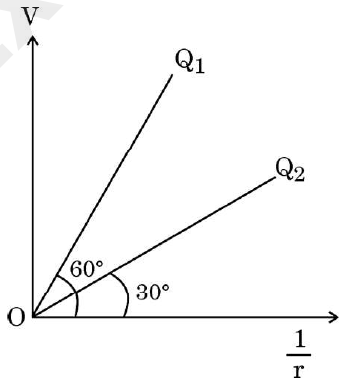 (c) An electric dipole of dipole moment of is kept in a uniform electric field of such that the dipole moment and the electric field are parallel. Calculate the potential energy of the dipole. (2)OR(c) An electric dipole of dipole moment is initially kept in a uniform electric field such that is perpendicular to . Find the amount of work done in rotating the dipole to a position at which becomes antiparallel to . (2)
[CBSE 2023 55/4/1]
Solution:
(a) For a uniformly charged thin conducting shell (charge , radius ):Inside (): (no charge enclosed by a Gaussian surface).On and outside (): , maximum just at the surface and falling as .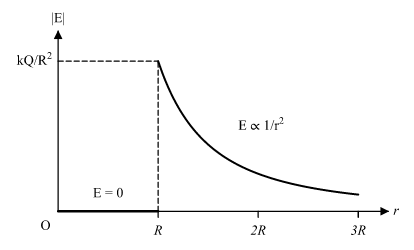 (b) For a point charge , so the graph of against is a straight line through the origin with slope , i.e. slope .(c) Potential energy of a dipole in a uniform field: , so :Result: (minimum energy, stable equilibrium).OR (c) Work done in rotating a dipole from to in a uniform field:Here (perpendicular) and (antiparallel):Result:
© examsnet.com
Go to Question: