Test Index
Electrostatic Potential and Capacitance
Electrostatic Potential and Capacitance

 CBSE Board Videos
© examsnet.com
Question : 19 of 28
Marks:
+1,
-0
(a) (i) Obtain the expression for the capacitance of a parallel plate capacitor with a dielectric medium between its plates.(ii) A charge of is given to a hollow metallic sphere of radius . Find the potential at (i) the surface and (ii) the centre of the sphere.OR(b) (i) A charge is placed on a thin conducting spherical shell of radius R. Use Gauss's theorem to derive an expression for the electric field at a point lying (i) inside and (ii) outside the shell.(ii) Show that the electric field for same charge density is twice in case of a conducting plate or surface than in a nonconducting sheet.
[CBSE 2024 55/3/2]
Solution:
(a)(i) Capacitance with a dielectric:Let the plates have area , separation and charges (surface charge density , ), with a dielectric of dielectric constant filling the space between them.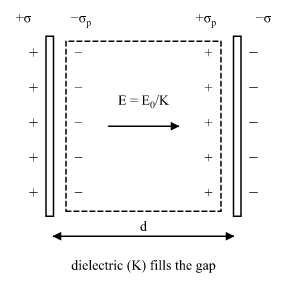 Without the dielectric the field is .The field polarises the dielectric: induced charges and appear on its faces next to the positive and negative plates. These oppose the original field, so the net field isPotential difference between the plates:Capacitance:i.e. , where is the capacitance with vacuum between the plates.(a)(ii) Given: , (1) At the surface, the shell acts as if its charge were at the centre:(2) Inside a hollow conductor , so the potential does not change from the surface to the centre:Result: at the surface and at the centre.OROR (b)(i) Field of a charged thin spherical shell (Gauss's theorem):Gauss's theorem: . By symmetry, is radial and has the same magnitude at all points of a sphere concentric with the shell, so on a Gaussian sphere of radius : .
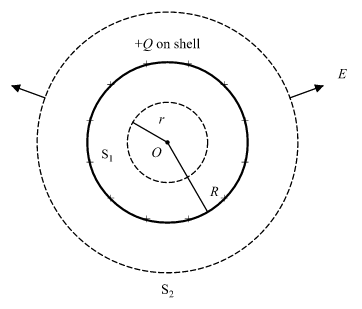 (1) Point inside (): Gaussian surface encloses no charge (all of lies on the shell).(2) Point outside (): Gaussian surface encloses the whole charge ., directed radially outward.Outside, the shell behaves as if its whole charge were at its centre.(b)(ii)Conducting plate: The charge lies on the surface and the field inside the conductor is zero. Take a small cylindrical Gaussian surface of end area with one face just outside and the other inside the conductor. Flux passes only through the outer face:Thin non-conducting sheet: The field acts on both sides of the sheet. A cylinder through the sheet has flux through both end faces:For the same : , i.e. .
© examsnet.com
Go to Question: