Test Index
Electrostatic Potential and Capacitance
Electrostatic Potential and Capacitance

 CBSE Board Videos
© examsnet.com
Question : 18 of 28
Marks:
+1,
-0
The figure shows four pairs of parallel identical conducting plates, separated by the same distance and arranged perpendicular to x-axis. The electric potential of each plate is mentioned. The electric field between a pair of plates is uniform and normal to the plates.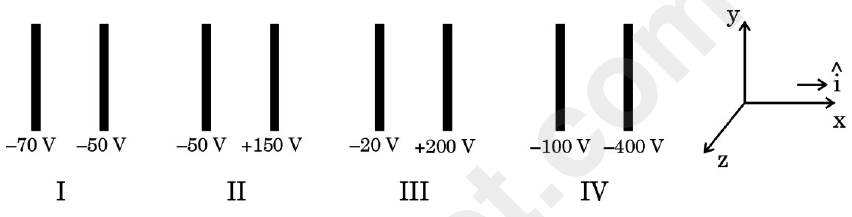 (i) For which pair of the plates is the electric field along ? (1)(A) I (B) II (C) III (D) IV(ii) An electron is released midway between the plates of pair IV. It will : (1)(A) move along at constant speed(B) move along at constant speed(C) accelerate along (D) accelerate along (iii) Let be the potential at the left plate of any set, taken to be at . Then potential V at any point between the plates of that set can be expressed as : (1)(A) (B) (C) (D) where is a constant, positive or negative.(iv) (a) Let , , and be the magnitudes of the electric field between the pairs of plates, I, II, III and IV respectively. Then : (1)(A) (B) (C) (D) OR(b) An electron is projected from the right plate of set I directly towards its left plate. It just comes to rest at the plate. The speed with which it was projected is about : (1)(Take )(A) (B) (C) (D)
[CBSE 2024 55/3/2]
Solution:
Concept:The electric field points from higher to lower potential, . For a uniform field between plates a distance apart, , with .(i) is along only if the left plate is at the higher potential.I: (rises), II: (rises), III: (rises), IV: (falls).Only in pair IV does the potential fall along , so is along .Answer: (D) IV(ii) In pair IV, is along . The force on an electron, , is along and constant, so the electron, released from rest, accelerates along (towards the plate at higher potential).Answer: (D) accelerate along (iii) In a uniform field is constant, so changes linearly with : , where (positive or negative according to the direction of the field).Answer: (A) (iv)(a) with the same , so :, , , (, , , )So .Answer: (C) OR (iv)(b) In set I the electron goes from the right plate () to the left plate (), i.e. towards lower potential, through . It loses kinetic energy and just stops at the plate:Answer: (B)
© examsnet.com
Go to Question: