Test Index
Electromagnetic Induction
Electromagnetic Induction

 CBSE Board Videos
© examsnet.com
Question : 18 of 34
Marks:
+1,
-0
A conducting loop is placed in a magnetic field, normal to its plane. The magnitude of the magnetic field varies with time as shown in the figure. If , and are magnitudes of induced emfs during periods , and , then :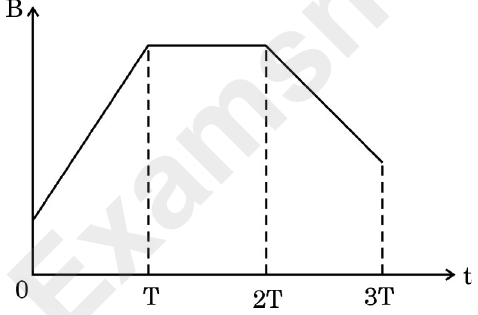
[CBSE 2024 55/2/2]
Solution:
Concept:By Faraday's law, . So the induced emf is proportional to the magnitude of the slope of the B–t graph.Solution:: B rises steeply, so the slope is largest: is the greatest.: B is constant, slope , so .: B falls, but less steeply than it rose in the first interval (the drop in B is smaller than the rise over the same time ), so .Hence .Key point: Only the rate of change of B matters, not the value of B. The flat part has the largest B but zero emf.Answer:Option D ()
© examsnet.com
Go to Question: