Test Index
Electromagnetic Induction
Electromagnetic Induction

 CBSE Board Videos
© examsnet.com
Question : 17 of 34
Marks:
+1,
-0
Consider the arrangement of two coils P and Q shown in the figure. When current in coil P is switched on or switched off, a current flows in coil Q.(a) Explain the phenomenon involved in it.(b) Mention two factors on which the current produced in coil Q depends.(c) Give the direction of current in coil Q when there is a current in the coil P and (i) R is increased, and (ii) R is decreased.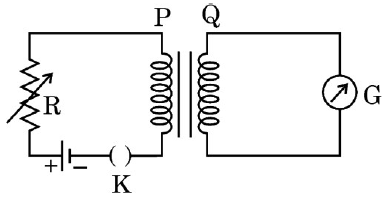
[CBSE 2024 55/1/2]
Solution:
(a) The phenomenon is mutual induction. When the current in coil P is switched on or off, it changes from zero to its steady value (or back). The magnetic flux produced by P that links coil Q therefore changes, and by Faraday's law an emf is induced in Q, which drives a current through the galvanometer G. When the current in P is steady, the flux is constant and no current flows in Q.(b) The current in coil Q depends on (any two):1. The rate of change of current in coil P ().2. The mutual inductance of the coils, which depends on the number of turns of P and Q, their area, their separation and orientation, and the core (soft iron increases it).3. The resistance of the circuit of coil Q ().(c) By Lenz's law, the induced current opposes the change in flux that causes it.(i) R increased: the current in P decreases, so the flux through Q decreases. The induced current in Q flows in the same direction as the current in P, to support the decreasing flux.(ii) R decreased: the current in P increases, so the flux through Q increases. The induced current in Q flows in the opposite direction to the current in P, to oppose the increase.The galvanometer therefore deflects in opposite directions in the two cases.
© examsnet.com
Go to Question: