Test Index
Electromagnetic Induction
Electromagnetic Induction

 CBSE Board Videos
© examsnet.com
Question : 12 of 34
Marks:
+1,
-0
(a) (i) State Lenz's law and explain how this law is a consequence of conservation of energy principle.(ii) A square shaped loop of side is initially lying outside a region of uniform magnetic field as shown in the figure. The loop is moved towards right with a constant velocity till it goes out of the region of magnetic field.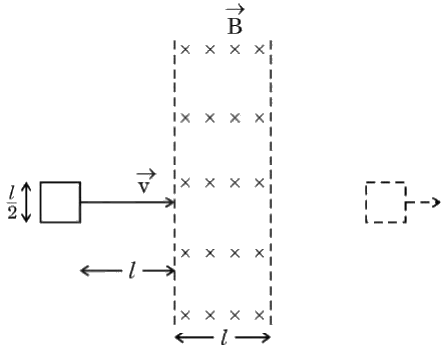 (I) What will be the directions of induced current when the loop enters the field and when it leaves the field?(II) Draw the plots showing the variation of magnetic flux linked with the loop with time and variation of induced emf with time . Mark the relevant values of , and on the graphs.OR(b) (i) Differentiate between peak and rms values of alternating current. How are they related?(ii) A current element X is connected across an ac source of emf . It is found that the voltage leads the current in phase by radian. If element X was replaced by element Y, the voltage lags behind the current in phase by radian.(I) Identify elements X and Y by drawing phasor diagrams.(II) Obtain the condition of resonance when both elements X and Y are connected in series to the source and obtain expression for resonant frequency. What is the impedance value in this case?
[CBSE 2025 55/4/3]
Solution:
(a)(i)Lenz's law: The polarity of the induced emf is such that the current it produces opposes the change in magnetic flux that produced it.Consequence of conservation of energy: When the north pole of a magnet is pushed towards a coil, the induced current makes the near face of the coil a north pole, which repels the magnet. Work must be done against this repulsion to keep the magnet moving, and this mechanical work appears as electrical energy (and heat) in the coil. If the induced current instead helped the change (near face a south pole), the magnet would be pulled in faster and faster, producing current and kinetic energy without any work being done: a perpetual source of energy, which violates conservation of energy. Hence the induced current must oppose the change.(a)(ii)Take into the page (the crosses). The loop's side is , its right edge starts at distance from the field, and the field region is wide.(I) Entering: the inward flux through the loop increases, so the induced current produces an outward field: anticlockwise current (as seen from the front).Leaving: the inward flux decreases, so the induced current produces an inward field: clockwise current.(While the loop is completely inside the field the flux is constant and there is no current.)(II) Timeline (speed ): to : loop outside the field, , to : entering, rises linearly with time to ; to : completely inside, (constant), to : leaving, falls linearly to ; with the opposite signAfter : , Using :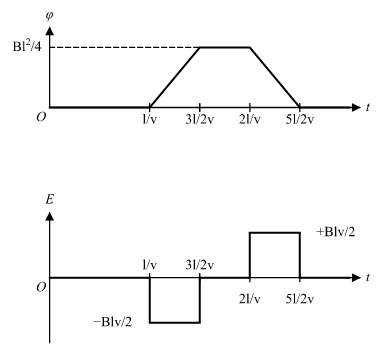 OR (b)(i)Peak value : the maximum value the alternating current reaches in a cycle ().rms value : the value of the steady (dc) current that produces the same heat in a resistor in the same time as the ac does; it is the square root of the mean of over a cycle.Relation: , so (similarly ).OR (b)(ii)(I) In a pure inductor the voltage leads the current by ; in a pure capacitor the voltage lags the current by .
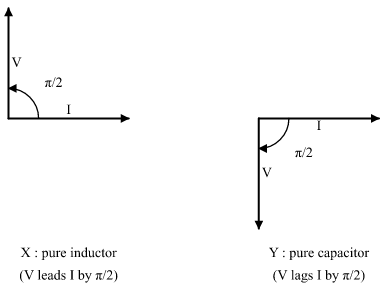 So X is a pure inductor () and Y is a pure capacitor ().(II) In series, the same current flows through both. leads by and lags by , so they are opposite in phase:, impedance Resonance: current is maximum when is minimum, i.e. when :Result: resonant frequency At resonance (for ideal elements with no resistance), so the current would in theory become very large (infinite).
© examsnet.com
Go to Question: