Test Index
Electromagnetic Induction
Electromagnetic Induction

 CBSE Board Videos
© examsnet.com
Question : 11 of 34
Marks:
+1,
-0
(a) Obtain an expression for the self-inductance of a long solenoid of length '', cross-sectional area 'A' and having 'N' turns.(b) The figure shows the plot of magnitude of induced emf () versus the rate of change of current in two coils '1' and '2'. Which coil has greater value of self-inductance and why?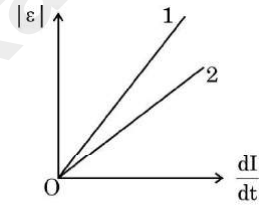
[CBSE 2025 55/4/3]
Solution:
(a)Let a current flow in the solenoid. Number of turns per unit length .Magnetic field inside a long solenoid: Flux through each turn , so total flux linkageBy definition , so(If the solenoid has a core of relative permeability , .)(b)The induced emf in a coil is . So the graph of against is a straight line through the origin whose slope equals .Line 1 is steeper than line 2, so coil 1 has the greater self-inductance: for the same rate of change of current it has a larger induced emf.
© examsnet.com
Go to Question: