Test Index
Electric Charges and Fields
Electric Charges and Fields

 CBSE Board Videos
© examsnet.com
Question : 8 of 29
Marks:
+1,
-0
(a) (i) Two point charges and are held at and in x-y plane. Obtain an expression for the net electric field due to the charges at a point . Hence, find electric field at a far off point .(ii) Three point charges of nC, nC, and nC are kept at the vertices A, B and C of an equilateral triangle of side m. Find the total amount of work done in shifting the charges from A to , B to and C to . Here , and are the midpoints of sides AB, BC and CA, respectively.OR(b) (i) Show that Gauss's theorem is consistent with Coulomb's law. Using it, derive an expression for the electric field due to a uniformly charged thin spherical shell of radius at a point at a distance from the centre of the shell such that (I) , and (II) .(ii) A point charge of nC is kept at the origin of a three-dimensional coordinate system. Find the type and magnitude of the charge which should be kept at so that the potential due to the system becomes zero at .
[CBSE 2025 55/4/3]
Solution:
(a)(i)The point P is on the equatorial line of the dipole. Both charges are at the same distance from P, so the two fields have equal magnitude: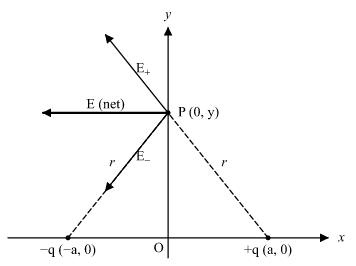 points away from and points towards . Their y-components cancel and their x-components add, both along . Each x-component is with :With dipole moment (from to ):For a far-off point , :Result: , i.e. magnitude , directed opposite to (along ).(a)(ii)Concept: Work done in shifting the charges (slowly) = change in electrostatic potential energy of the system, , with ., , are midpoints of the sides, so they form an equilateral triangle of side m. The same three pairs of charges are at m instead of m.Sum of pair products: J J JResult: J (negative: the field of the system does this work as the net attracting system shrinks)OR (b)(i)Gauss's law from Coulomb's law: Take a point charge at the centre of a sphere of radius . By Coulomb's law, , radially outward at every point of the sphere, so everywhere.This is Gauss's law . Conversely, applying Gauss's law to this sphere gives back , which is Coulomb's law. So the two are consistent.Field of a thin spherical shell (radius , total charge ): by symmetry is radial and has the same magnitude at all points at distance from the centre. Take a concentric spherical Gaussian surface of radius .(I) : the Gaussian surface encloses the whole charge .(the shell acts as if all its charge were at the centre; with )(II) : the Gaussian surface encloses no charge. (no field inside the shell)OR (b)(ii)Given: nC at the origin, at , field point PDistances: m, m nCResult: a negative charge of magnitude nC ( C)
© examsnet.com
Go to Question: